Affiliate Marketing for Startups: Complete Guide
Affiliate marketing for startups is an operating system—locks, cost, recruit, rates, tracking, first 100 sales, then diagnose a flat roster.
TikTok Shop affiliate marketing: sellers set 1%-80% via Open or Target collabs, pay on revenue minus refunds, typically 15 days after delivery.

TL;DR: TikTok Shop affiliate marketing is seller-priced performance pay inside TikTok’s shop. Sellers set commissions between 1% and 80% of GMV, choose Open or Target collaboration (Target can also use a flat fee), and may add a separate Shop Ads rate. Creators earn (revenue minus refunds) times that rate, typically 15 days after delivery.
Most “TikTok Shop affiliate rates” posts invent a category average. They treat the Shop like Amazon Associates Table 1. It is not. The seller picks the percentage. The platform sets the rails: who can promote, how refunds cut pay, and when money clears.
TikTok Shop affiliate marketing is the in-app collaboration system where merchants pay creators for tracked shop sales. This page sits next to how affiliate marketing works, affiliate commission structures, digital product affiliate marketing vs physical goods, best affiliate marketing platforms, affiliate marketing disclosure rules, and whitelisting and Spark Ads explained.
TikTok Shop affiliate marketing is a commission-based partnership where a seller enrolls products for creators to promote inside TikTok Shop, and creators earn a share of qualifying sales made through their shoppable content. The seller sets the rate. TikTok tracks the order, applies refunds, and settles commission on a delivery-linked clock.
That is classic CPS economics with marketplace packaging. It is not the same product as Spark Ads or paid Partnership Ads, which buy distribution rights on creative. Keep those jobs separate. See whitelisting and Spark Ads when the question is paid amplification, not affiliate commission.
For the wider affiliate contract (ID, window, event, approval, payout, disclosure), start with how affiliate marketing works. This article owns the Shop-specific collab types, rate band, formula, and payout rules.
TikTok Shop affiliate marketing matters because it is one of the few mainstream social surfaces where product discovery, checkout, and creator payout sit in one stack. Get the rate and collab type wrong and you either starve creator supply or light margin on fire.
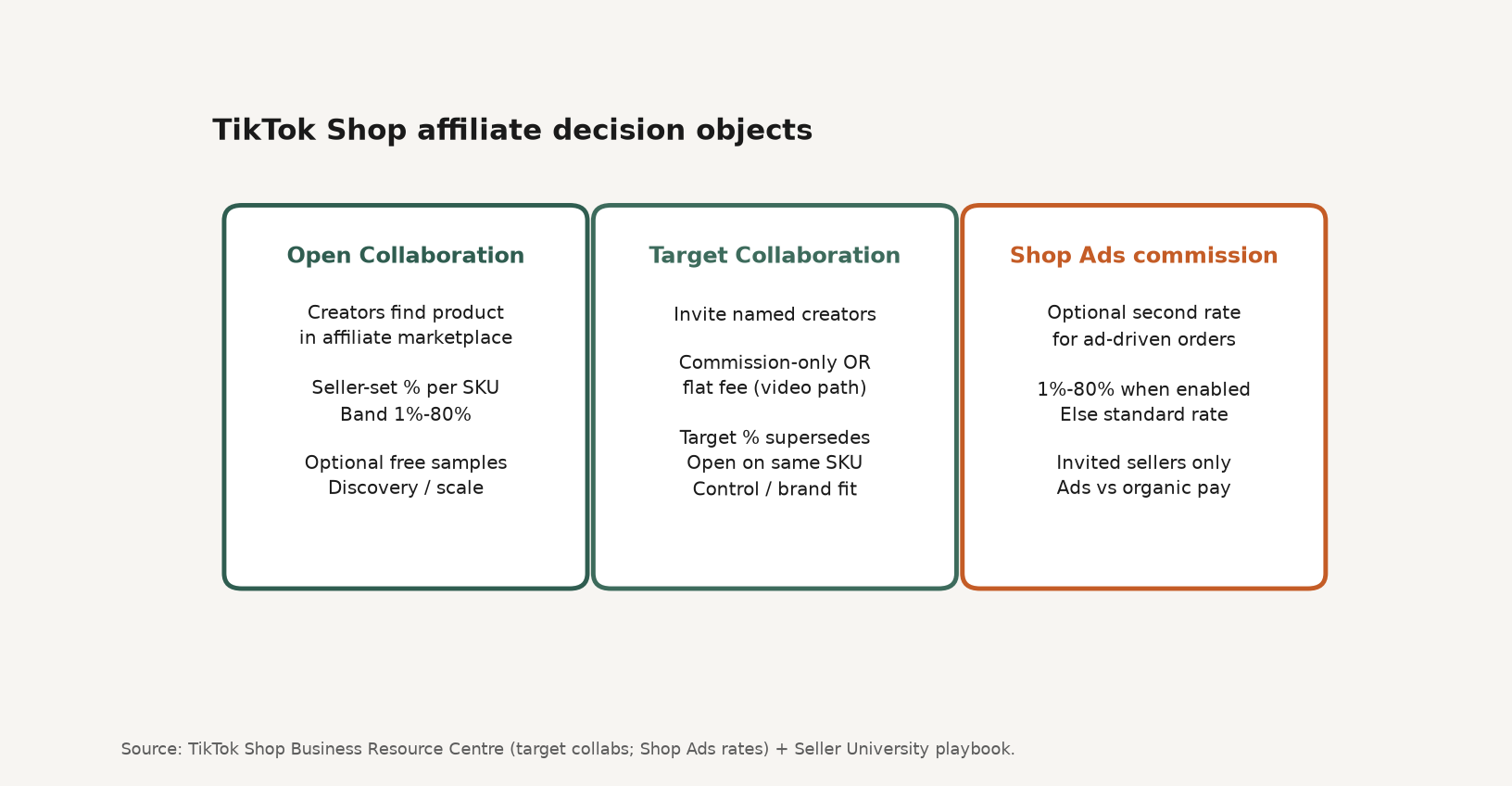
Source: TikTok Shop Business Resource Centre (target collaborations; Shop Ads commission rates) and Seller University collaboration playbook. Editorial framework.
TikTok Shop affiliate marketing works as a seller-configured CPS program inside TikTok Shop: pick collaboration type, set a rate inside 1%-80%, let creators attach products to content, then settle commission on net revenue after refunds on a delivery-linked schedule. Read the rails before you copy a blog’s “average rate.”
| Object | Who promotes | How you pay | Notes |
|---|---|---|---|
| Open Collaboration | Approved creators who find the product in the affiliate marketplace | Seller-set % per product (platform band 1%-80%) | Marketplace-visible; free samples optional per seller tools |
| Target Collaboration | Invited creators only | Commission-only or flat fee (flat fee via TikTok Shop; video approval path) | Target rate supersedes Open on the same product |
| Shop Ads commission | Creators on ad-driven orders (when enabled) | Separate 1%-80% rate, or standard rate if toggle is off | Setting available to invited sellers |
Sources: Target collaborations, Shop Ads commission rates, UK collaboration playbook (Open/Target structure).
A UK Seller University playbook states that 10%-15% “will be an average commission rate” inside the Open/Target matrix, while still requiring rates inside 1%-80%. Treat 10%-15% as regional guidance language, not a verified US category census. There is no public dataset here for average US TikTok Shop commissions by niche.
TikTok’s US University page states the formula in plain text: Commission = (Revenue - Refunds) × Commission rate. After purchase, creators see an estimated commission. That estimate is not final. Final pay follows actual revenue after the after-sales window (US University).
| Outcome | Actual commission |
|---|---|
| No refund | Equals estimated commission |
| Partial refund | (Actually paid price - refund amount) × rate |
| Full refund or cancel | $0 |
On a labeled $100 of qualifying revenue with $0 refunds, commission is $5 at 5%, $10 at 10%, $15 at 15%, $20 at 20%, and $30 at 30%. Refunds cut that base. Coupons and promotions can also move estimated vs actual.
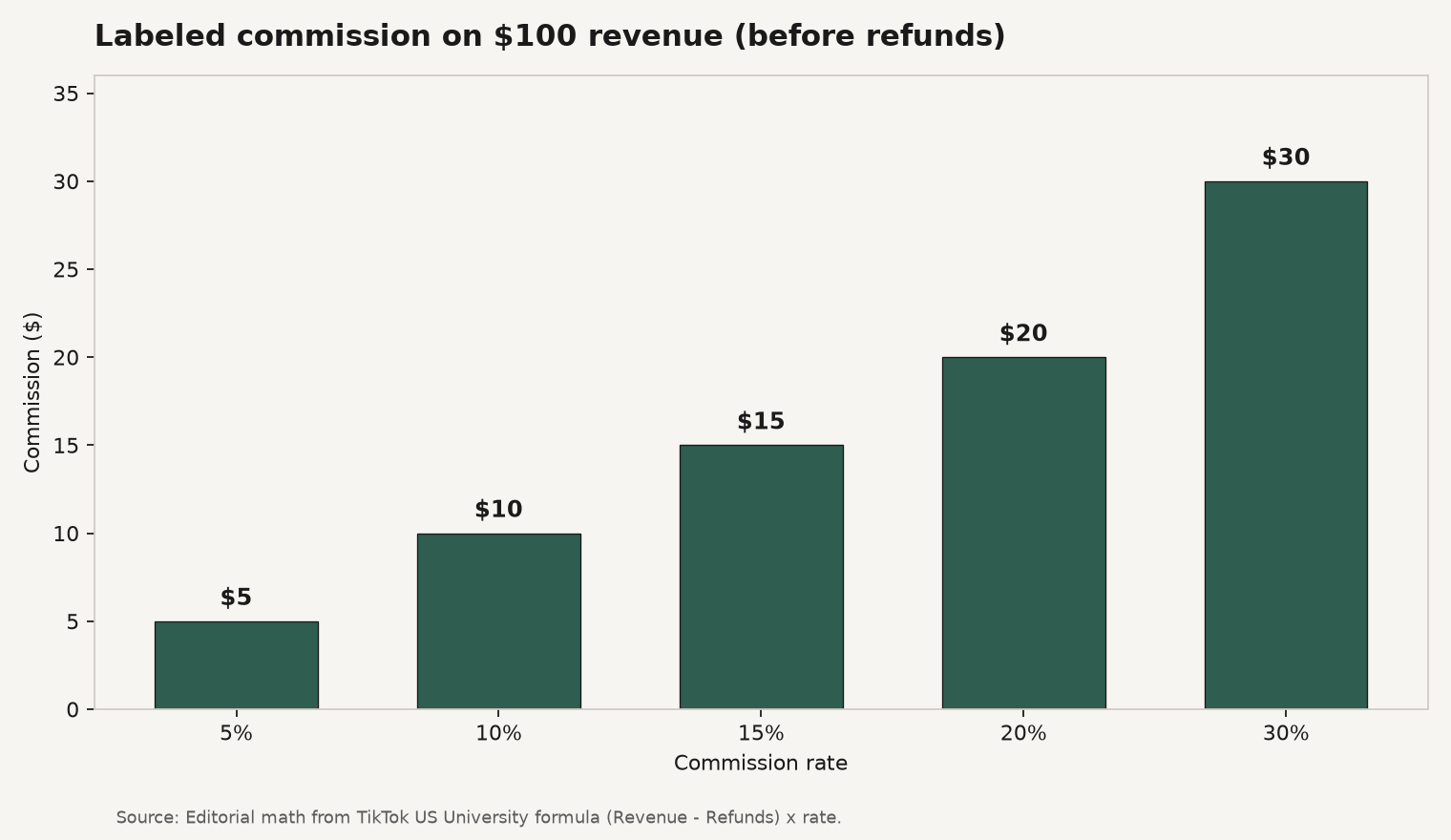
Source: Editorial math from TikTok Shop US University formula Commission = (Revenue - Refunds) × Commission rate. https://seller-us.tiktok.com/university/essay?knowledge_id=6077860360177451
For margin context outside the Shop, Shopify’s published affiliate bands still put many physical programs near 5%-15% and digital near 20%-50% (Shopify). Use that when you are deciding whether TikTok Shop’s ask fits the same SKU’s contribution margin. Details live in digital vs physical affiliate offers and affiliate commission structures.
Starting April 15, 2025 (UTC+0), creators typically receive commission on the 15th day after the order delivery date. Some orders take longer when the seller’s settlement period is Delivery + 31 days, or when disputes, refunds, or returns remain open. Commission cannot pay until those issues resolve (Affiliate orders FAQs).
TikTok also documents 30-day commission protection for creators already promoting a product: rate increases apply immediately; rate decreases keep the prior rate for the lock window (standard decreases include a 2-day notice before the drop; Shop Ads decreases use the 30-day grace without that 2-day notice). Removing a product from showcase ends the locked rate (US University).
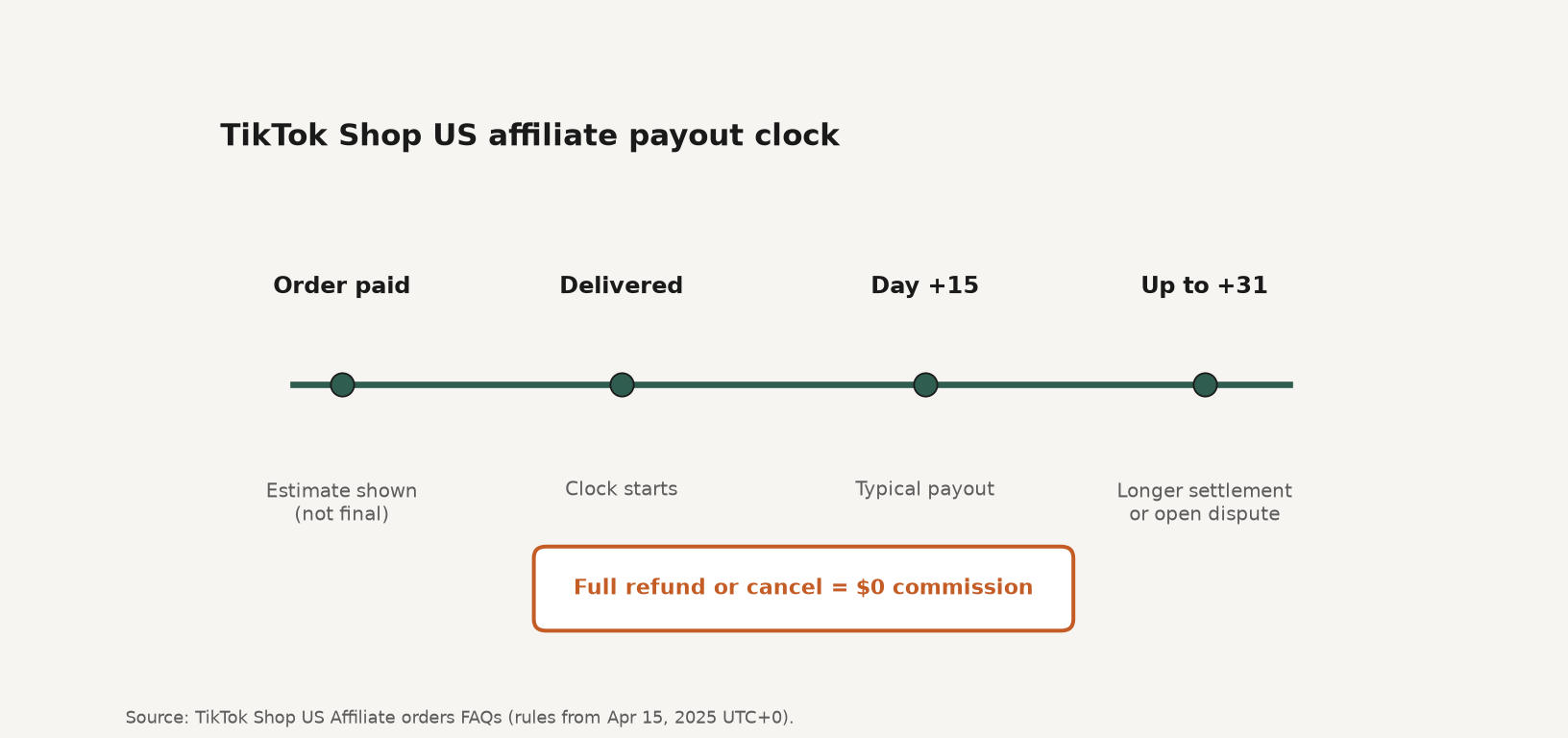
Source: TikTok Shop US University affiliate orders FAQs (payout rules effective April 15, 2025). https://seller-us.tiktok.com/university/essay?knowledge_id=2467877215749930
TikTok Shop is a catalog marketplace seat with creator collaboration tools, not a classic network like Awin and not a SaaS partner stack like Rewardful. Match the job the way best affiliate marketing platforms frames platform types. If you need co-branded storefronts outside a single social checkout, that is a different surface than Shop affiliate.
Setting up TikTok Shop affiliate marketing is a seller checklist: qualify products, choose Open vs Target, set rates inside the allowed band, decide samples and Shop Ads rates, then monitor estimated vs settled commission. Creators mirror that with showcase picks, content, and earnings checks.
Q: What is TikTok Shop affiliate marketing? A: TikTok Shop affiliate marketing is a seller-configured program where creators promote shop products in TikTok content and earn commission on qualifying sales. Sellers set rates and collaboration type. TikTok tracks orders, applies refunds, and settles pay on a delivery-linked schedule.
Q: What commission rates can sellers set on TikTok Shop? A: TikTok documents affiliate commissions between 1% and 80% of GMV per order for target collaborations, and the same 1%-80% band for optional Shop Ads commission rates. A UK playbook mentions 10%-15% as average guidance. That is not a verified US category census.
Q: What is the difference between Open and Target collaboration? A: Open Collaboration makes products available for creators to find and promote with your set rate. Target Collaboration invites specific creators and can use commission-only or flat-fee structures. If both exist on one product, the Target commission rate supersedes the Open rate.
Q: When do TikTok Shop creators get paid affiliate commission? A: Under US rules effective April 15, 2025, creators typically receive commission on the 15th day after delivery. Payment can wait until Delivery + 31 days when seller settlement is longer, or until disputes, refunds, or returns close.
Q: Does estimated TikTok Shop commission equal final pay? A: No. TikTok calculates final commission as (Revenue - Refunds) × rate. Partial refunds shrink pay. Full refunds and cancels pay $0. The estimate shown after purchase ignores later refunds.
TikTok Shop affiliate marketing is a seller-priced CPS rail, not a fixed public rate card. Set Open and Target correctly, stay inside the 1%-80% band, budget for refunds, and plan cash on Delivery+15. Creators should read estimated commission as a ceiling that refunds can cut. If you want distribution beyond one social checkout, list on feat. and let affiliates sell through co-branded storefronts.
Affiliate marketing for startups is an operating system—locks, cost, recruit, rates, tracking, first 100 sales, then diagnose a flat roster.
How to track affiliate sales: pick link cookie, coupon, pixel, S2S postback, or storefront checkout—then match Rewardful, Tapfiliate, or Impact.
Best affiliate programs for SaaS companies pass the Recurring Cap Test: labeled duration, cookie, seat type, payout rails—plus Rewardful’s ~24% planning band.