Performance Marketing KPI Benchmarks by Channel
Performance marketing KPI benchmarks by channel: WordStream search, Triple Whale Meta 1.88 vs Google 3.27 ROAS, Dreamdata LinkedIn 121%.
How iOS privacy changes affected performance marketing: ATT cut conversion CTR ~37% in research, hurt Meta-heavy Shopify sales, forced MMM and lift tests.

TL;DR: How iOS privacy changes affected performance marketing is a measurement story first. Apple’s App Tracking Transparency (ATT) on iOS 14.5 (April 26, 2021) required permission before cross-app tracking or IDFA access. Research finds conversion-optimized Meta ads lost about 37% CTR versus click-optimized ads after ATT, Facebook-dependent Shopify advertisers saw roughly 26% fewer new-customer orders, and operators rebuilt proof with first-party signals, MMM, and lift tests.
Most founders still ask whether iOS “killed Facebook ads.” The better question is how iOS privacy changes affected performance marketing: which signals disappeared, which dashboards lied, and which proof stack replaced them.
ATT did not ban paid social. It removed the clean identity glue that made platform ROAS feel like a complete P&L. Merchants who treated Ads Manager as ground truth cut winning channels or doubled losing ones. Merchants who moved proof to first-party events, marketing mix modeling, and incrementality tests kept buying demand with eyes open.
Key takeaways:
App Tracking Transparency is Apple’s permission system that requires apps to ask users before tracking them across other companies’ apps and websites or accessing the Identifier for Advertisers (IDFA).
Performance marketing is media and creative optimized for a defined conversion event (purchase, lead, install) against a CPA, ROAS, or CPL target. Before ATT, many performance stacks assumed durable device identifiers and long click attribution windows. After ATT, those assumptions broke on iOS for users who declined tracking.
Apple shipped ATT with iOS 14.5 on April 26, 2021 (Apple Newsroom). Related pieces of the stack include SKAdNetwork (privacy-preserving app install attribution), Aggregated Event Measurement on Meta web conversion paths, and server-side Conversions API (CAPI) uploads of first-party events. None of those restore pre-ATT pixel omniscience. They trade precision for consent and aggregation.
For merchants, the practical definition is simpler: your ad platform lost a large share of deterministic identity on iOS, so reported conversions, audience quality, and bid optimization degraded unless you rebuilt the signal path.
Privacy changes matter because they rewrote the scoreboard, not because they outlawed ads. Teams that kept optimizing to broken attribution fired channels that still drove sales, or poured money into audiences the algorithm could no longer find.
Why this still earns a page in 2026:
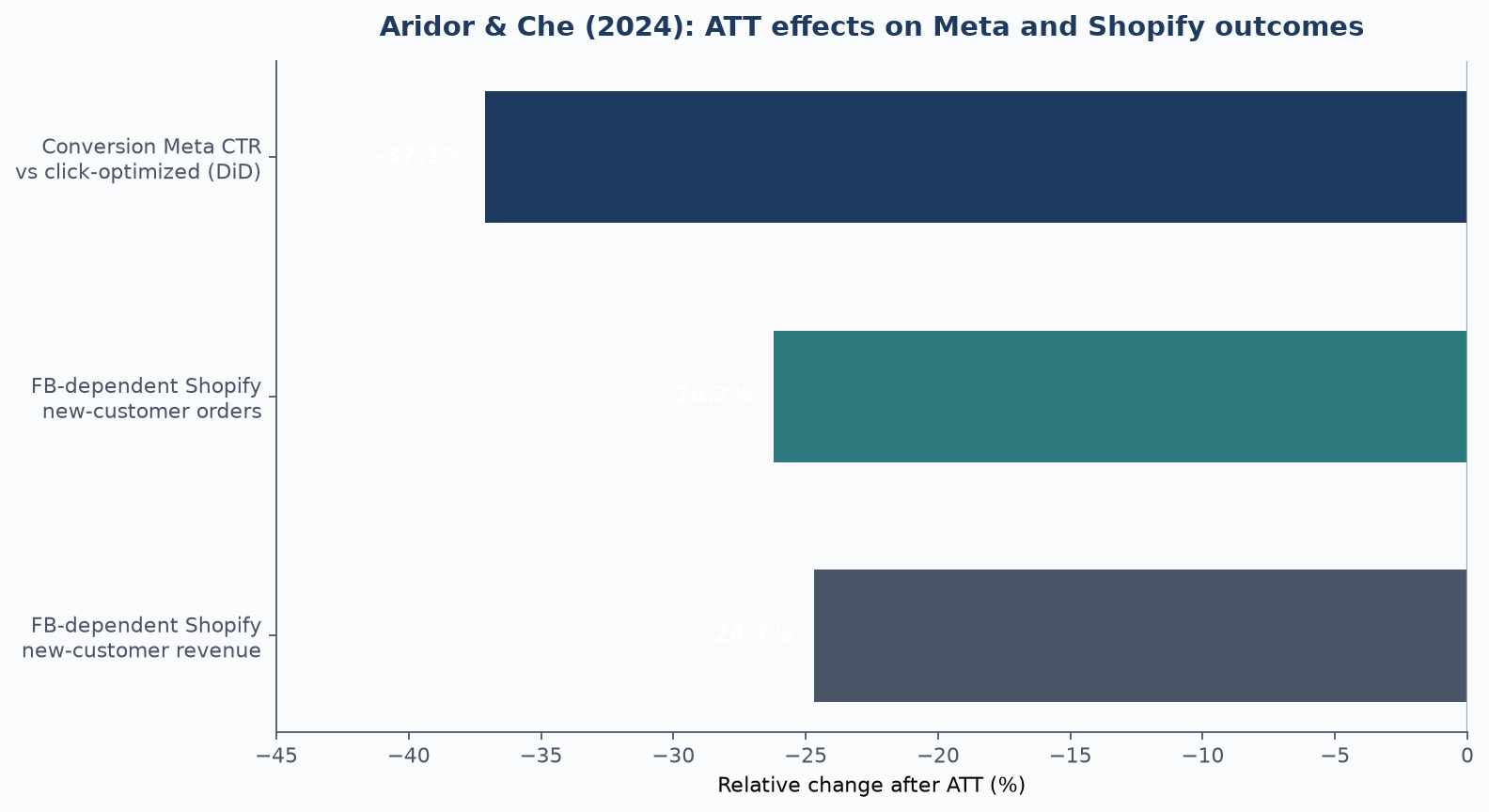
Source: Aridor and Che (2024), within-advertiser DiD and Shopify outcomes. https://www.tse-fr.eu/sites/default/files/TSE/documents/sem2024/eco_platforms/aridor2024.pdf
How iOS privacy changes affected performance marketing is a three-layer stack: identity loss (ATT/IDFA), auction and creative degradation (harder conversion optimization), and measurement redesign (AEM, CAPI, SKAN, then MMM and lift). Paid social still works. Platform-reported ROAS stopped being a complete picture of performance.
| Period | What changed | Operator implication |
|---|---|---|
| Apr 26, 2021 | iOS 14.5 ships ATT | IDFA and cross-app tracking require opt-in |
| 2021-2022 | Meta Aggregated Event Measurement, shorter windows, CAPI push | Prioritize events; rebuild server signals |
| 2022 | Meta discusses ~$10B ATT revenue impact order of magnitude | Platform pricing and inventory shift |
| 2023-2026 | MMM, geo/user lift, cleaner first-party data become default proof | Stop managing the company from Ads Manager alone |
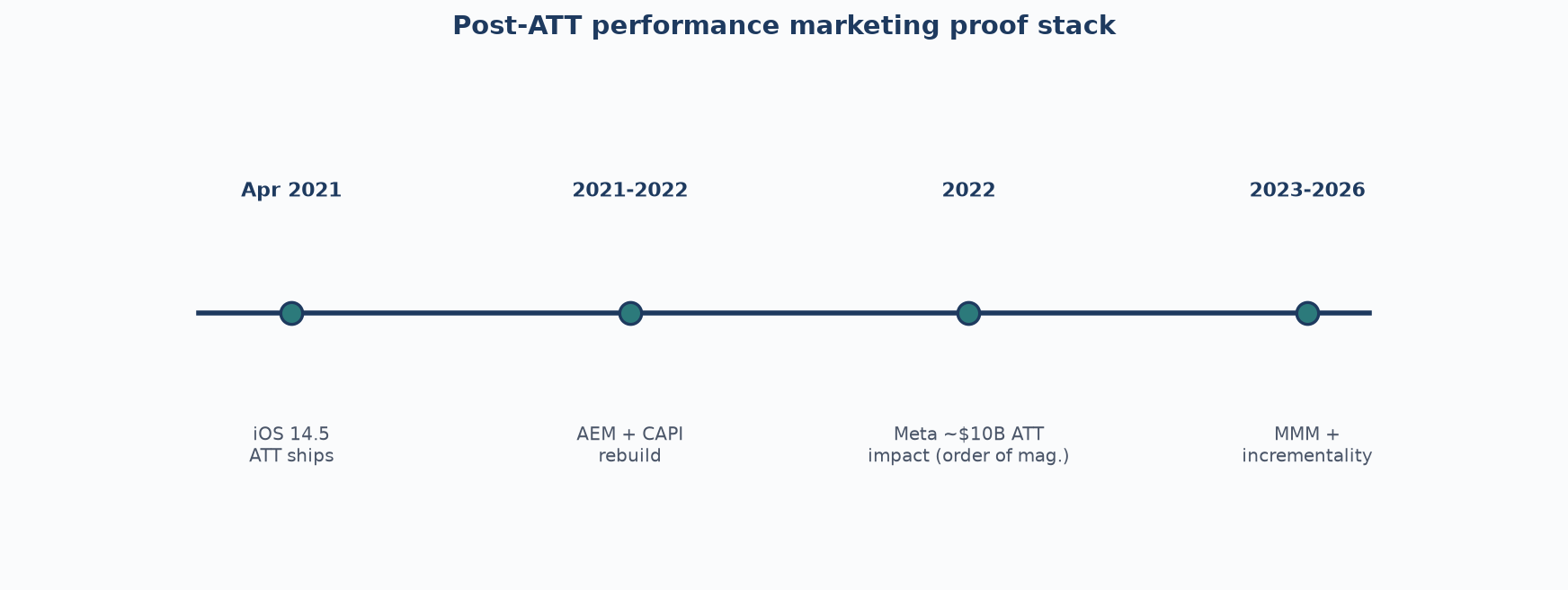
Source: Editorial timeline combining Apple ATT launch (Apr 26, 2021), Meta measurement redesign era, Meta Q1 2022 earnings context, and post-ATT proof stack (MMM + lift). Apple: https://www.apple.com/newsroom/2021/04/ios-14-5-offers-unlock-iphone-with-apple-watch-diverse-siri-voices-and-more/ ; Meta: https://s21.q4cdn.com/399680738/files/doc_financials/2022/q1/Meta-Q1-2022-Earnings-Call-Transcript.pdf
Guy Aridor and Yeon-Koo Che study Meta advertisers around ATT with a within-advertiser design that compares conversion-optimized campaigns to click-optimized campaigns. The headline targeting result: conversion-optimized ads saw a 37.1% relative CTR decline versus click-optimized ads after ATT, with a similar rise in CPC in their DiD frame (Aridor & Che). They also report aggregate Facebook conversion-optimized CTR down about 7.7% after ATT and cost per conversion up nearly 50%, with explicit measurement caveats on those aggregates.
On outcomes, advertisers more dependent on Facebook saw 26.2% fewer new-customer orders and 24.7% less new-customer revenue in Shopify data after ATT, controlling for ad spend. Advertisers substituted toward the Google ecosystem, yet Facebook-dependent firms still took acquisition hits (Aridor & Che). That pattern matches what founders felt: “ROAS died” was often “identity died, so the optimizer and the report both got worse.”
Related MSI working paper material aligns with the ~37% conversion-vs-click CTR degradation story for Meta after ATT (MSI Report 24-124). Use the academic papers for causal claims. Use agency blogs for operator color only.
Common Thread Co’s ecommerce Facebook sample shows ROAS 3.13 pre-iOS window (Feb-Apr 2021) versus 1.93 post (Jul-Sep 2021), a -38.41% change, with CPM $11.60 to $12.85 (+10.75%) (Common Thread Co). That is useful as a contemporaneous operator chart. It is not a census of all advertisers. Pair it with Aridor and Che before you rewrite your media plan.
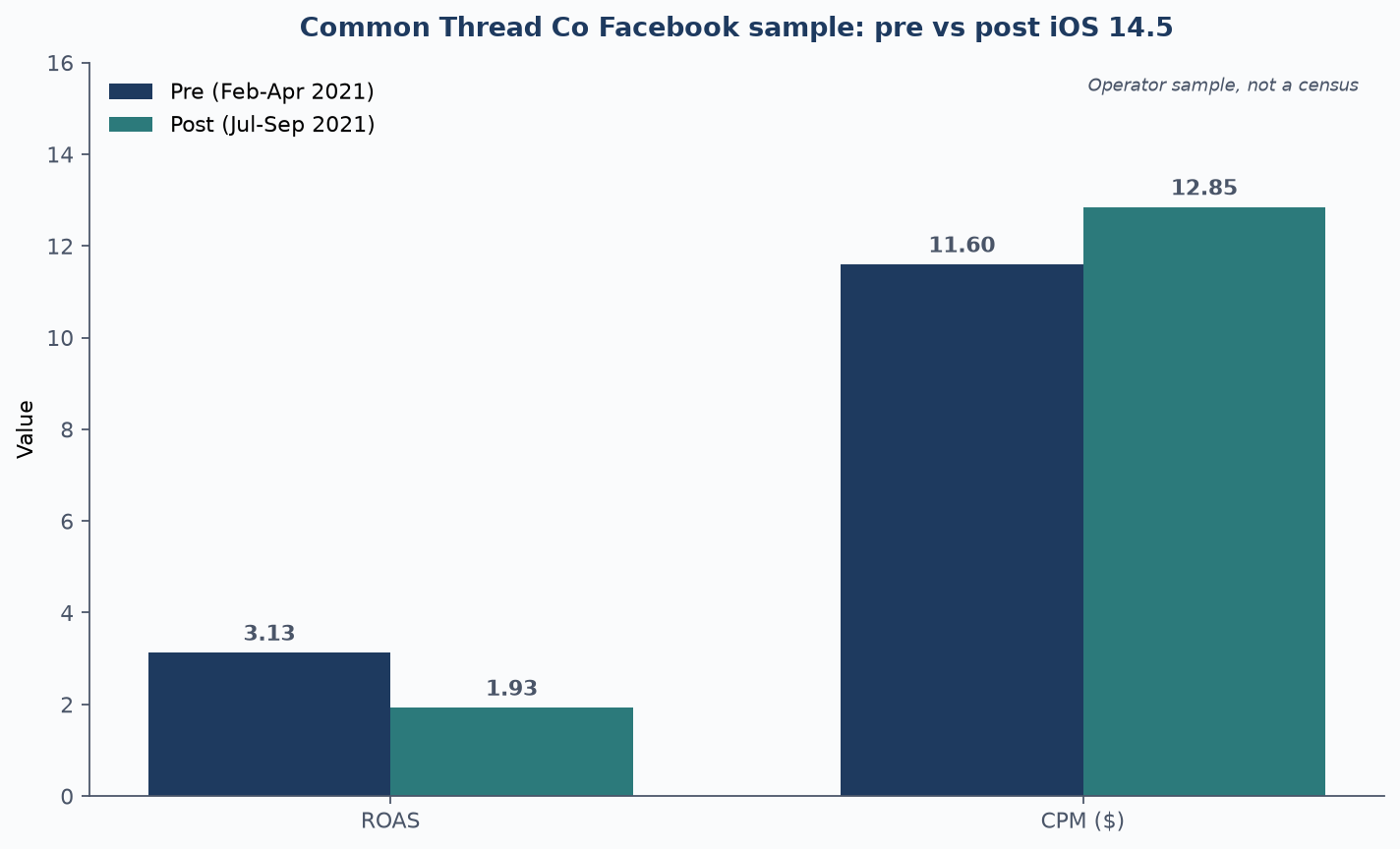
Source: Common Thread Co Facebook ads iOS 14 ecommerce analysis (operator sample). https://commonthreadco.com/blogs/coachs-corner/facebook-ads-ios-14-ecommerce
| Layer | Pre-ATT assumption | Post-ATT reality |
|---|---|---|
| Identity | Durable IDFA / cross-app stitching for many users | Opt-in required; large share unavailable |
| Optimization | Conversion events train auctions tightly | Weaker training data; conversion campaigns degrade vs simpler objectives |
| Reporting | Long click windows, pixel-heavy ROAS | Aggregated events, shorter windows, under-reported conversions |
| Audiences | Lookalikes and retargeting from rich pools | Smaller, noisier pools; first-party lists matter more |
| Budgeting | Ads Manager ROAS as P&L proxy | Need MMM, lift, and finance reconciliation |
Q: How did iOS privacy changes affect performance marketing? A: ATT (iOS 14.5, April 2021) required permission before cross-app tracking or IDFA access, which weakened identity-based targeting and attribution. Academic work finds conversion-optimized Meta ads lost about 37% CTR versus click-optimized ads after ATT, and Facebook-dependent Shopify advertisers saw large drops in new-customer orders and revenue. Operators responded with CAPI, aggregated measurement, MMM, and incrementality tests.
Q: Did App Tracking Transparency kill Facebook ads? A: No. ATT degraded deterministic tracking and conversion optimization for many advertisers, which made platform ROAS look worse and raised acquisition costs for Meta-heavy merchants. Paid social still converts when creative, offer, and first-party signals are strong. The illusion that Ads Manager alone was a complete P&L is what died.
Q: What is the Meta ATT revenue impact figure? A: On Meta’s Q1 2022 earnings call, leadership discussed roughly $10 billion as an order-of-magnitude ATT-related revenue impact for 2022. Treat it as platform-scale context, not a forecast for your account’s ROAS.
Q: What should brands use instead of platform ROAS after ATT? A: Keep platform ROAS as a directional optimization input, then prove spend with first-party revenue reconciliation, marketing mix modeling for mix and saturation, and incrementality tests for causal lift. Attribution models still help for journey diagnostics, but last-click alone is a weak ATT-era scorecard.
Q: Is there one official ATT opt-in rate? A: No. Apple does not publish a single global opt-in census for all apps and years. Third-party snapshots (Flurry, AppsFlyer, and others) conflict by cohort and method. Prefer named-source ranges for a specific date and app category, or skip the number.
How iOS privacy changes affected performance marketing is settled enough to act on: ATT broke identity-heavy optimization and reporting, Meta-scale economics and Shopify outcomes moved, and the winners rebuilt proof outside the ad UI. Your job is not to mourn the pixel. It is to buy demand with first-party signals, MMM, and lift tests while creative and offers still do the selling.
If you built a product and want distribution without pretending last-click ROAS is the whole story, list it on feat. and let affiliates sell through co-branded storefronts.
Performance marketing KPI benchmarks by channel: WordStream search, Triple Whale Meta 1.88 vs Google 3.27 ROAS, Dreamdata LinkedIn 121%.
CAC vs LTV benchmarks by industry: Skok's 3:1 floor, Aleph's 4.1x SaaS median, First Page Sage industry ratios, and why payback months matter.
Affiliate marketing for startups is an operating system—locks, cost, recruit, rates, tracking, first 100 sales, then diagnose a flat roster.