Affiliate Marketing for Startups: Complete Guide
Affiliate marketing for startups is an operating system—locks, cost, recruit, rates, tracking, first 100 sales, then diagnose a flat roster.
Go-to-market strategy frameworks compared: PLG, SLG, product-led sales, and partner motions, with Bain's ~2x PLG growth finding and when hybrids win.

TL;DR: Go-to-market strategy frameworks compared means matching your motion to constraints, not picking a tribe. Bain finds primarily product-led firms grew revenue in 2022 nearly twice as fast as peers with little PLG focus, and were almost three times as likely to gain market share. Hybrids (product-led sales) and partner-led distribution exist because self-serve alone hits ceilings. Pick by ACV, complexity, and whether buyers can finish without a human.
Founders treat go-to-market strategy frameworks compared like a personality test. You are “PLG” or you are “sales-led,” and the other side is a failure of courage. That framing wastes years.
The real question is narrower: who creates demand, who qualifies it, and who is allowed to close when the product cannot. Bain’s 2023 work shows primarily product-led software firms grew revenue nearly twice as fast in 2022 as companies with limited or no PLG focus, and were almost three times as likely to have gained market share (Bain). McKinsey’s public-SaaS analysis warns that averages hide a high-performing subset. Most “we do PLG” adopters do not get the headline lift (McKinsey).
Key takeaways:
Go-to-market strategy frameworks are named patterns for how a company creates demand, qualifies buyers, and closes revenue, usually defined by who leads: product, sales, marketing, or partners.
They are not org charts. They are constraint fits. PLG assumes end users can discover, try, buy, and expand with limited human help. SLG assumes a human must map a complex product to a multi-stakeholder purchase. PLS assumes the product can qualify, but procurement or expansion still needs a rep. Partner-led assumes someone else’s audience or storefront can sell what you built for a tracked split (revenue split models for collaborative selling).
OpenView popularized the PLG label for what Slack, Calendly, and Zoom-style motions already practiced: the product as the primary driver of acquisition, conversion, and expansion. Bain’s definition matches that family: end users discover, try, buy, and scale usage in a self-serve manner (Bain). The framework argument starts when founders pretend only one of these patterns can exist inside one company.
Wrong motion taxes CAC and culture at the same time. You hire enterprise AEs for a $29 self-serve SKU, or you refuse to staff sales while six-figure deals stall in security review.
Why the comparison earns a page:
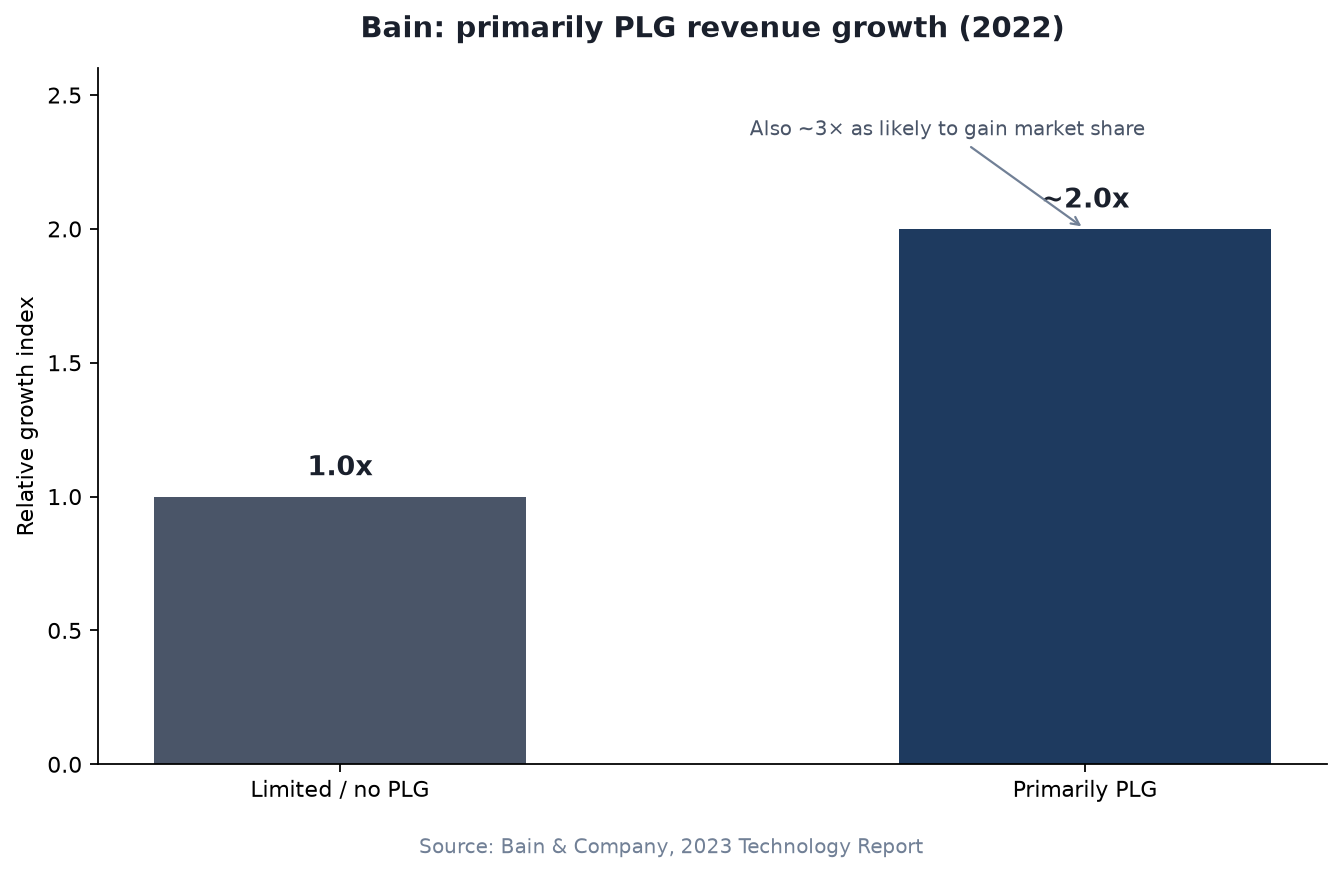
Source: Bain & Company, How Enterprise Sales Can Supercharge Product-Led Growth (2023 Technology Report). https://www.bain.com/insights/how-enterprise-sales-can-suphercharge-product-led-growth-tech-report-2023/
Frameworks compare cleanly when you score three constraints: can the buyer self-serve value, how high is ACV, and how complex is deployment or procurement. Then you assign a primary motion and optional secondary motions with handoff rules.
| Motion | Who leads | Best when | Lead signal | Main failure mode |
|---|---|---|---|---|
| Product-led (PLG) | Product + self-serve | Fast time-to-value; end user can buy; broad free→paid base | Signups, activation, expansion usage | Hits enterprise procurement ceiling |
| Sales-led (SLG) | SDR/AE | High complexity; high ACV; multi-stakeholder buy | MQL/SQL, outbound | High CAC; slow cycles; weak product proof |
| Product-led sales (PLS) | Product first, sales on signal | Self-serve works, but large accounts need humans | PQLs / usage thresholds | Sales cannibalizes self-serve without floors |
| Partner-led / marketplace | Affiliates or co-sellers | Distribution outside your owned audience | Partner-attributed sales | Weak tracking, disclosure, or offer fit |
Partner-led is the motion most SaaS GTM pages skip. If creators or affiliates already reach your buyer, a tracked revenue split can outrun another SDR pod. Mechanics live in how affiliate marketing works and revenue split models. Brand versus performance budget fights are adjacent, not identical (content marketing vs performance marketing).
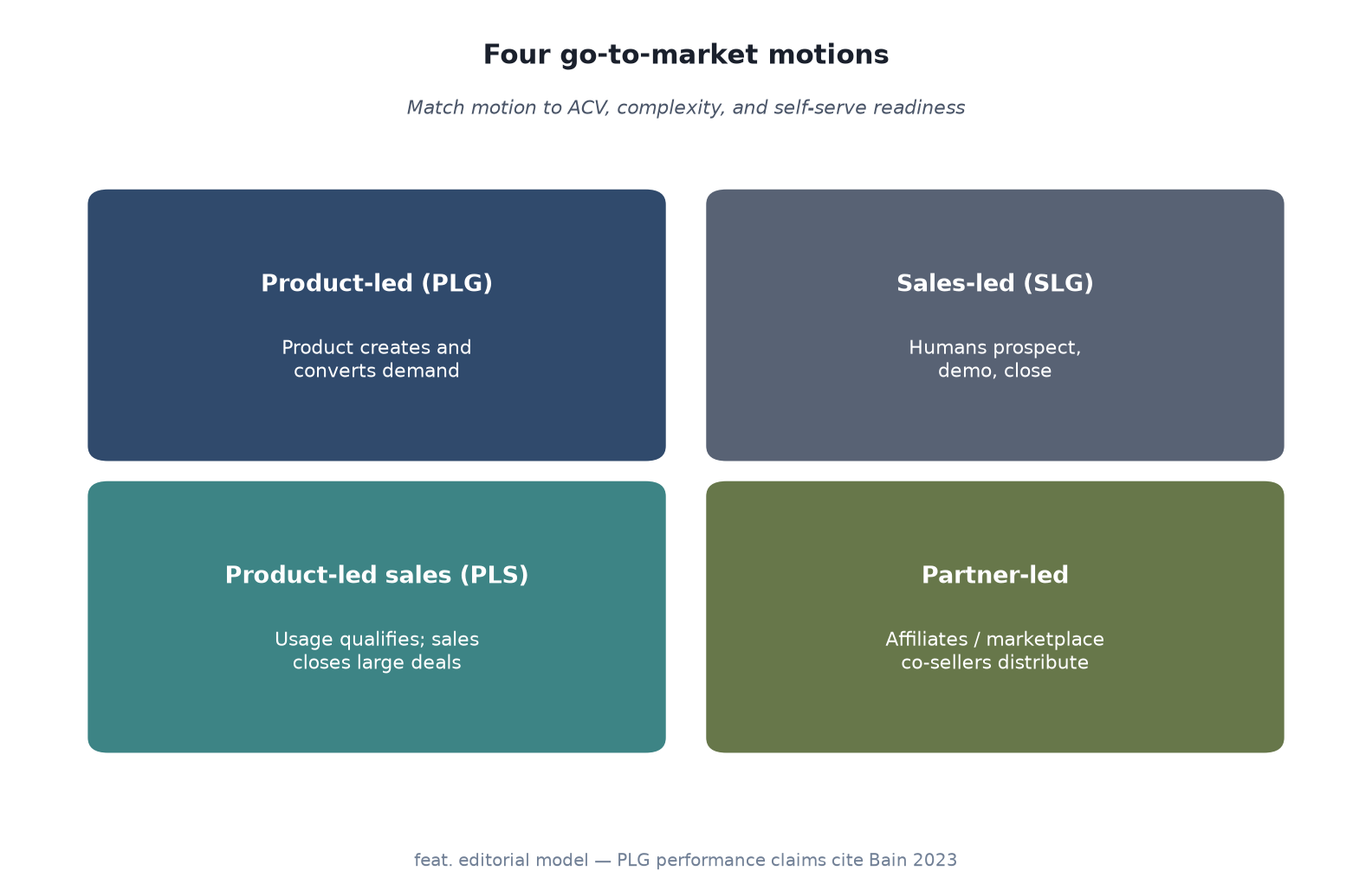
Source: feat. editorial four-motion model for this article. Performance claims for PLG vs non-PLG use Bain 2023; partner-led is a distribution pattern, not a Bain category.
Bain’s fit list is blunt. PLG works best when configuration and deployment are quick, end users can make purchase decisions, the product is sticky with growing usage, the free or trial base is broad, and tiers entice upgrades (Bain). Capability checklist from the same research family: about 75% of surveyed PLG companies use a consumption-based pricing meter, more than 90% publish transparent pricing, and about 95% offer user-driven onboarding through videos and guides (Bain).
If your product needs a three-week services engagement before value, calling it PLG is cosplay. Ship a sales-assisted pilot instead.
Sales-led growth remains the right default for high ACV, heavy integration, and buyers who will not swipe a card. The product may still need demos, security reviews, and custom contracts. SLG fails when you use it to paper over a product that cannot show value in a sandbox. Then you fund CAC without proof.
Unit-economics floors still matter whatever the motion. The 3:1 LTV:CAC planning habit belongs next to this choice (CAC vs LTV benchmarks by industry).
PLS is not “hire AEs and keep the free tier logo on the homepage.” It is a routing system. Product usage creates product-qualified leads. Sales engages accounts that hit firmographic and behavioral thresholds. Self-serve stays open for everyone else.
Bain documents company-specific triggers, not a universal law: Twilio routes to enterprise sales around $100,000 ACV; Dropbox when at least 3% of employees already use the product (Bain). Operator blogs invent single ACV floors for every category. There is no public census that makes “$15K” true for all products. Calibrate against your win rates and sales cost per account.
McKinsey’s hybrid framing (product-led sales) exists because pure self-serve often cannot clear enterprise value. Their public-company work also says labeling yourself PLG without the operating model is not a strategy (McKinsey).
Partner-led GTM uses affiliates, resellers, or marketplace co-sellers to put your offer in front of audiences you do not own. It pairs with any of the three product/sales motions. A PLG SKU can still pay creators a tracked commission. An SLG enterprise deal can still have a referral partner.
For digital products and creator distribution, the funnel stages still need one job per URL (how to build a digital product funnel). Attribution rules decide who gets paid when partners and ads share a journey (attribution models compared).
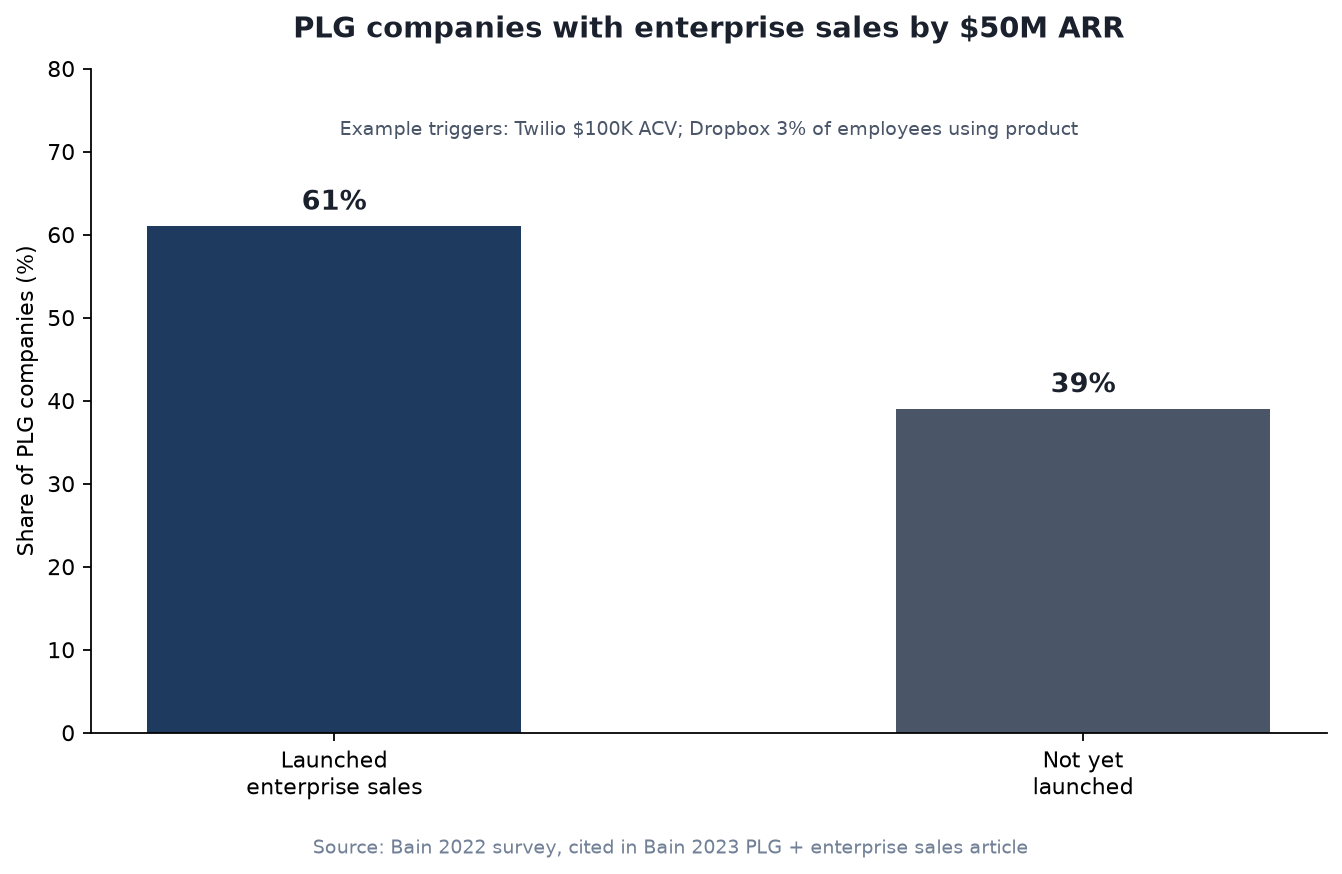
Source: Bain & Company, How Enterprise Sales Can Supercharge Product-Led Growth (2022 Bain survey cited in 2023 article). https://www.bain.com/insights/how-enterprise-sales-can-suphercharge-product-led-growth-tech-report-2023/
Choose the primary motion with constraints, then write handoff rules before you hire.
Q: What is the difference between PLG and SLG? A: Product-led growth uses the product for acquisition, conversion, and expansion, usually through free trials or freemium. Sales-led growth uses humans to prospect, demo, and close, usually for complex or high-ACV deals. Many companies run both with clear handoff rules.
Q: What is product-led sales? A: Product-led sales is a hybrid where product usage creates qualified demand, then sales engages high-intent accounts for larger or more complex deals. Self-serve remains open for buyers who never need a rep. It is not the same as cold outbound with a free tier sticker.
Q: When should a PLG company add enterprise sales? A: Bain finds about 61% of PLG companies launch an enterprise sales team by $50M in annual revenue. Practical triggers include stalled free-to-paid conversion in large accounts, low wallet share, or usage already inside a company without a centralized deal. Timing should follow evidence, not a calendar.
Q: Does PLG mean lower sales and marketing spend? A: No. Bain’s public-company analysis shows primarily PLG firms spend more on both R&D and sales and marketing as a percentage of revenue, while generating more revenue growth per sales-and-marketing dollar. PLG changes where you invest. It does not delete GTM cost.
Q: Is partner-led go-to-market a real framework? A: Yes, as a distribution motion. Affiliates and marketplace co-sellers create tracked demand you do not buy with ads or SDR hours. It usually sits beside PLG, SLG, or PLS rather than replacing product or sales. Treat tracking, disclosure, and offer fit as first-class design.
Go-to-market strategy frameworks compared is a constraint problem: self-serve readiness, ACV, and complexity decide whether product, sales, hybrid PLS, or partners should lead. Bain’s primarily-PLG performance edge is real for the right markets, and so is the hybrid path that adds enterprise sales before the ceiling hardens. McKinsey’s caveat still stands: the label without the operating model does not print growth.
If your distribution gap is creators who could sell what you built through co-branded storefronts and a revenue split, start at feat..
Affiliate marketing for startups is an operating system—locks, cost, recruit, rates, tracking, first 100 sales, then diagnose a flat roster.
Build a commission-based sales network as a single-tier seller graph—economics, surface, named sellers, then density. Rewardful: only 1.28% of affiliates sell.
Build a product distribution network on four rails—DTC, wholesale, commission sellers, co-branded storefronts. Densify before you scale; Lowe’s pays up to 20% on storefronts.