Affiliate Marketing for Startups: Complete Guide
Affiliate marketing for startups is an operating system—locks, cost, recruit, rates, tracking, first 100 sales, then diagnose a flat roster.
Tapfiliate vs feat: Launch is $89/mo for 50 affiliates and 500 conversions; affiliate 51 means Scale at $179. feat. gives each seller a page.

TL;DR: Tapfiliate vs feat is a tracker-versus-page choice. Tapfiliate Launch costs $89/month for one program, 50 affiliates, 5,000 clicks, and 500 conversions, with no revenue share. Approving the 51st affiliate moves you to Scale at $179. feat. gives each approved seller a co-branded storefront. Pick Tapfiliate for tracked links into your checkout. Pick feat. when named sellers need a page.
Merchants comparing Tapfiliate vs feat usually start with price and end up arguing about features. Both miss the point. Tapfiliate is a tracker that hands an affiliate a link or coupon into your checkout. feat. hands an approved seller a co-branded page. The bill is a consequence of which one you need.
Tapfiliate is also unusually honest about its meters. Its help center publishes every Launch limit and every overage rate. That lets you do what most comparison pages skip: price your actual roster. The number that surprises people is not the $89. It’s what happens at affiliate number 51.
Key takeaways:
Tapfiliate vs feat is a comparison between Tapfiliate, affiliate tracking software that issues links and coupons into a merchant’s own checkout and prices by program, roster, and volume, and feat., a marketplace that gives each seller a merchant approves a co-branded storefront for that merchant’s product.
Tapfiliate is a broad tracker. Launch includes 30+ integrations (Shopify, WooCommerce, Stripe), recurring commissions, coupon tracking, and a branded affiliate dashboard. Scale adds affiliate groups, bonuses, product XML feeds, multi-level marketing, deeplinks, and automated payouts through Trolley (Tapfiliate pricing). It works for ecommerce and SaaS, which is why it shows up on both Shopify and Stripe shortlists.
feat. is a different first screen. A merchant lists a product and sets the revenue split. An approved seller gets their own co-branded page to share, and the split settles on the attributed sale. feat. does not recruit sellers for you. Affiliate software vs storefront covers that first-screen gap across ten tools. This page is the Tapfiliate-specific version, with the meters priced out.
Tapfiliate’s Launch plan caps the roster at 50 affiliates and counts everyone you’ve approved, not just the ones who sell. Passing 50 means moving to Scale at $179/month. So the cheapest plan rewards a curated roster and penalizes open approval, which is exactly the habit that activation data says to drop.
What the cap does to a real program:
None of this makes Tapfiliate a bad buy. It makes the roster your real pricing input.
The Roster Cap Test asks two questions. First, is the job a tracked link or coupon into your own checkout? If yes, price Tapfiliate against your approved roster and monthly conversions. Second, do the people selling need their own page? If yes, that’s a storefront job, and a tracker alone won’t produce it.
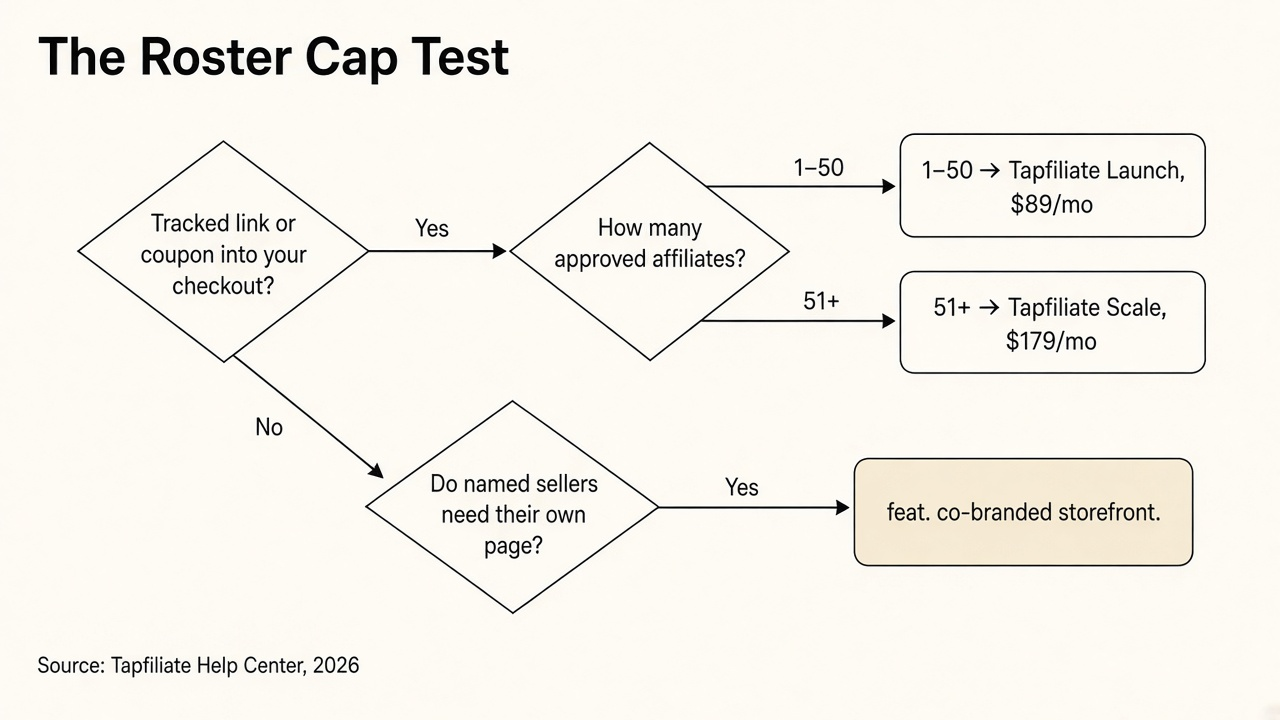
Source: Editorial decision flow based on Tapfiliate Help Center, 2026. https://support.tapfiliate.com/en/articles/12791930-find-the-ideal-tapfiliate-plan-to-maximize-your-affiliate-revenue
| Plan | Monthly | Annual | Affiliates | Programs | Clicks / mo | Conversions / mo | Team | Trial |
|---|---|---|---|---|---|---|---|---|
| Launch | $89 | $74/mo ($890/yr) | 50 | 1 | 5,000 | 500 | 1 | 7 days |
| Scale | $179 | $149/mo ($1,790/yr) | Unlimited | Unlimited | 100,000 | 10,000 | 5 | 14 days |
| Enterprise | Custom on pricing page; help center says from $599 | From $5,990/yr | Unlimited | Unlimited | Unlimited | Unlimited | Unlimited | 30 days |
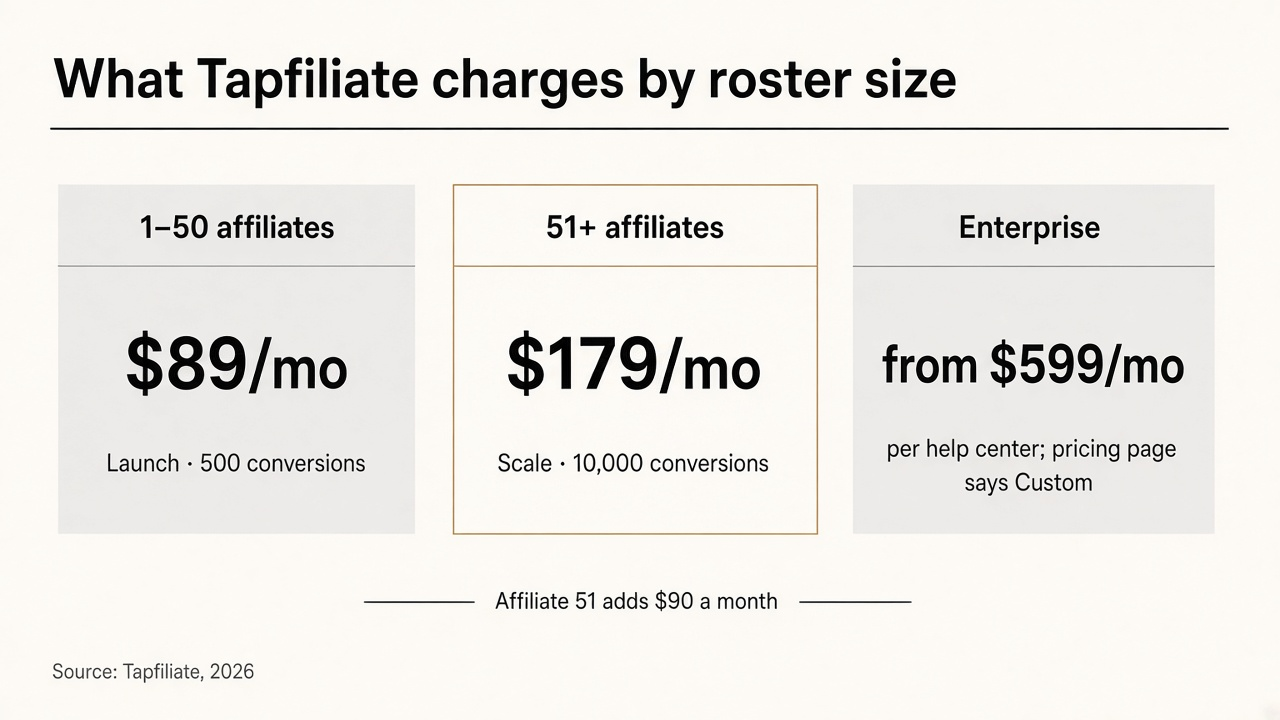
Source: Tapfiliate, 2026. https://tapfiliate.com/pricing/ · https://support.tapfiliate.com/en/articles/12791930-find-the-ideal-tapfiliate-plan-to-maximize-your-affiliate-revenue
The Enterprise line is the only inconsistency. The pricing page shows “Custom.” The help center says “Starts at $599/month or $5,990/year.” Ask for a quote before you budget the help center figure.
Tapfiliate is flat-priced, so the cost per conversion falls as volume rises, until you cross a cap. Here is Launch at three volumes, assuming 50 or fewer affiliates and clicks under 5,000. Every figure is arithmetic on the published rates.
| Launch, monthly billing | Monthly bill | Cost per conversion |
|---|---|---|
| 50 conversions | $89 | $1.78 |
| 500 conversions (at cap) | $89 | about $0.18 |
| 1,000 conversions (500 over at $15 per 1,000) | $96.50 | about $0.10 |
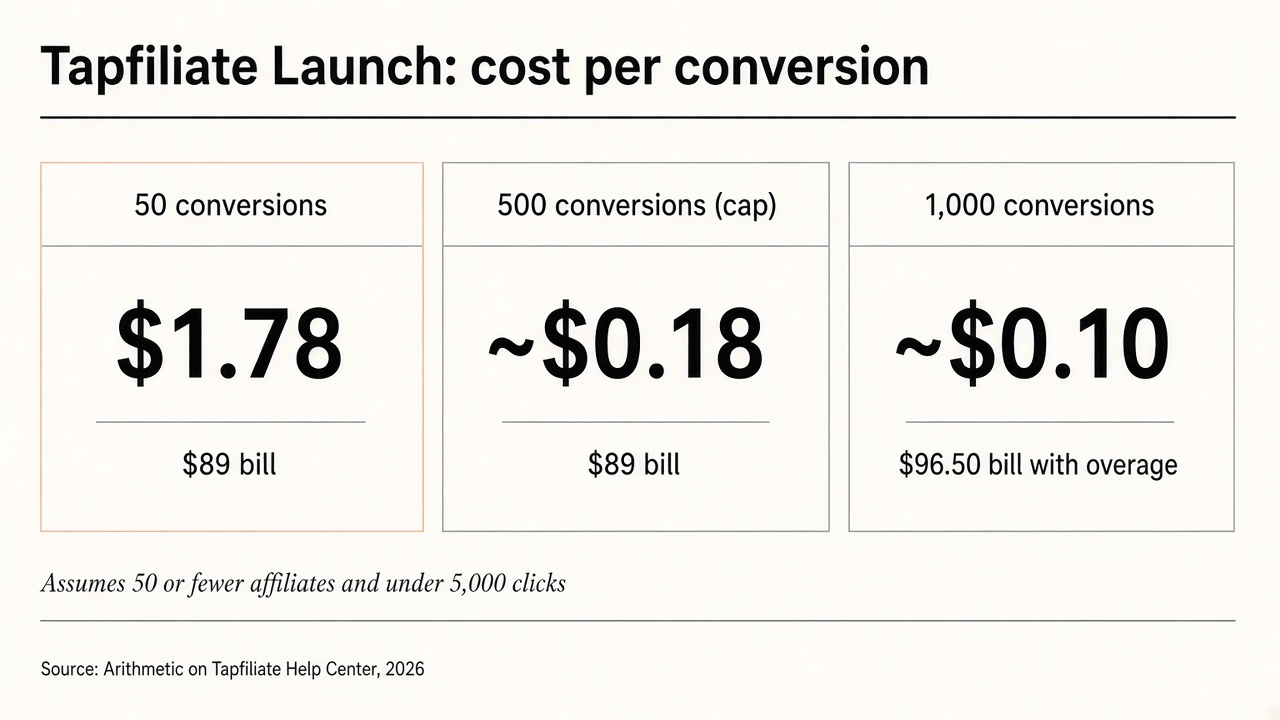
Source: Arithmetic on Tapfiliate Help Center, 2026. https://support.tapfiliate.com/en/articles/12791930-find-the-ideal-tapfiliate-plan-to-maximize-your-affiliate-revenue
The conversion meter is gentle. Going from 500 to 1,000 conversions adds $7.50. The affiliate meter is not. Going from 50 to 51 affiliates adds $90. If you’re comparing flat-fee trackers against percentage-fee apps like Refersion, Shopify affiliate apps compared prices that crossover at $10,000 a month in affiliate sales.
feat. starts from the seller, not the link. A merchant approves a person, and that person gets a co-branded storefront for the merchant’s product. Attribution sits on the storefront URL. The merchant’s split applies to the attributed sale. The seller has something to share that looks like a shop, not a long URL with a ?ref= on the end.
What I can’t give you is a fee comparison. feat. doesn’t publish a fee sheet on this page, so I won’t claim it’s cheaper at 51 sellers or at 1,000 conversions. The live terms show in the product. If you want a full loaded-cost model across trackers, how much it costs to build an affiliate program does that math.
Yes. A merchant can keep a tracker for the open program and add storefronts for the handful of sellers who need a page. The two don’t conflict as long as each sale is attributed once. If you do this, decide up front which system owns attribution for a given seller so nobody is paid twice.
These five steps pick the product. Each step is at most two sentences.
Q: What is the difference between Tapfiliate and feat.? A: Tapfiliate is affiliate tracking software that gives affiliates links and coupons into your own checkout, priced by program, roster, and volume. feat. gives each seller you approve a co-branded storefront for your product. One is a tracker. The other is a page.
Q: How much does Tapfiliate cost? A: Launch is $89/month, or $74/month billed annually at $890/year, for one program, 50 affiliates, 5,000 clicks, and 500 conversions. Scale is $179/month, or $149 annually, with unlimited affiliates. Tapfiliate says it charges no transaction fee or revenue share (checked 2026-10-06).
Q: How many affiliates can I have on Tapfiliate Launch? A: Fifty, in one active program. The 51st affiliate requires Scale at $179/month rather than an overage. Archived programs don’t count toward the program limit.
Q: Is Tapfiliate cheaper than feat.? A: There’s no honest answer to that yet, because feat. doesn’t publish a fee sheet and its live terms show in the product. What you can price is Tapfiliate’s side: $89 up to 50 affiliates, $179 above. Compare the destination you need first.
Q: Is feat. a Tapfiliate alternative? A: Only if your sellers need a page. If they need a tracked link or coupon and already have an audience, a tracker like Tapfiliate is the right tool. feat. is the alternative when a bare link won’t carry the sale.
Tapfiliate vs feat comes down to the destination. Tapfiliate gives affiliates a tracked link into your checkout for $89/month up to 50 affiliates and 500 conversions, then $179 on Scale. Price your approved roster before your traffic. feat. gives each seller you approve a co-branded page. If the people you can name need a shop to share, list your product on feat.
Affiliate marketing for startups is an operating system—locks, cost, recruit, rates, tracking, first 100 sales, then diagnose a flat roster.
How to track affiliate sales: pick link cookie, coupon, pixel, S2S postback, or storefront checkout—then match Rewardful, Tapfiliate, or Impact.
Best affiliate programs for SaaS companies pass the Recurring Cap Test: labeled duration, cookie, seat type, payout rails—plus Rewardful’s ~24% planning band.