Affiliate Marketing for Startups: Complete Guide
Affiliate marketing for startups is an operating system—locks, cost, recruit, rates, tracking, first 100 sales, then diagnose a flat roster.
How to negotiate affiliate commission rates: Shopify band anchors, a both-sides proof pack, and non-rate tradeables when the percentage cannot move.

TL;DR: How to negotiate affiliate commission rates starts with the category band your margin can fund, not with a random “ask for 50% more.” Affiliates bring attributed revenue and a promotion plan. Merchants answer with tier logic and cash-flow math. If the percentage is stuck, trade cookie window, payout hold, exclusivity, or a hybrid structure. Default rates are opening bids.
Most people treat the signup-page commission as law. It is usually an opening bid. The affiliates who earn more, and the merchants who keep top partners, renegotiate with proof inside a band the product can actually pay.
If you want to know how to negotiate affiliate commission rates, you need three tools: published industry envelopes, a proof pack (or a merchant “yes” rule), and a list of non-rate tradeables so the conversation does not die on one number.
Key takeaways:
Negotiating affiliate commission rates is the process of changing a partner’s payout terms (percentage, fixed fee, tiers, or related rules) after both sides exchange proof of value and margin constraints.
It is not the same as designing the base affiliate commission structure. Structure picks the event (sale, lead, recurring invoice). Negotiation moves where you sit inside a sustainable band, or swaps adjacent terms when the percentage is frozen.
Two seats at the table:
The tracking contract underneath stays the same as in how affiliate marketing works: unique ID, attribution window, qualifying event, approval, payout. Negotiation changes the commercial height of that contract, not the need for disclosure. Material connections still require clear FTC disclosure (FTC FAQ; disclosure rules).
Default rates are written for the median partner. Top partners leave, or under-promote, when the rate ignores their volume. Weak partners get overpaid when merchants raise the whole program instead of one tier.
Why the conversation is worth having:
You anchor to the published band, assemble proof (or a merchant yes-rule), make a specific ask, and keep non-rate tradeables ready. Affiliates negotiate up from a default. Merchants negotiate by promoting partners through tiers or approving custom terms that still clear margin.
Before you type an email, name the product type and the Shopify reference band:
| Offer type | Shopify-published band | Midpoint (illustrative) | Commission on $100 sale at midpoint |
|---|---|---|---|
| Physical goods | 5%-15% | 10% | $10 |
| Digital products / courses | 20%-50% | 35% | $35 |
| Subscriptions (recurring) | 15%-30% | 22.5% | $22.50 per billed period |
| High-ticket physical | 3%-8% | 5.5% | $5.50 |
Source: bands from Shopify. Midpoints and $100 math are an original analysis for negotiation framing, not a survey of live programs.
If you are at 25% on a digital offer and asking for 35%, you are asking for about +$10 per $100 sale at those midpoints. That sentence is clearer than “I want more.”
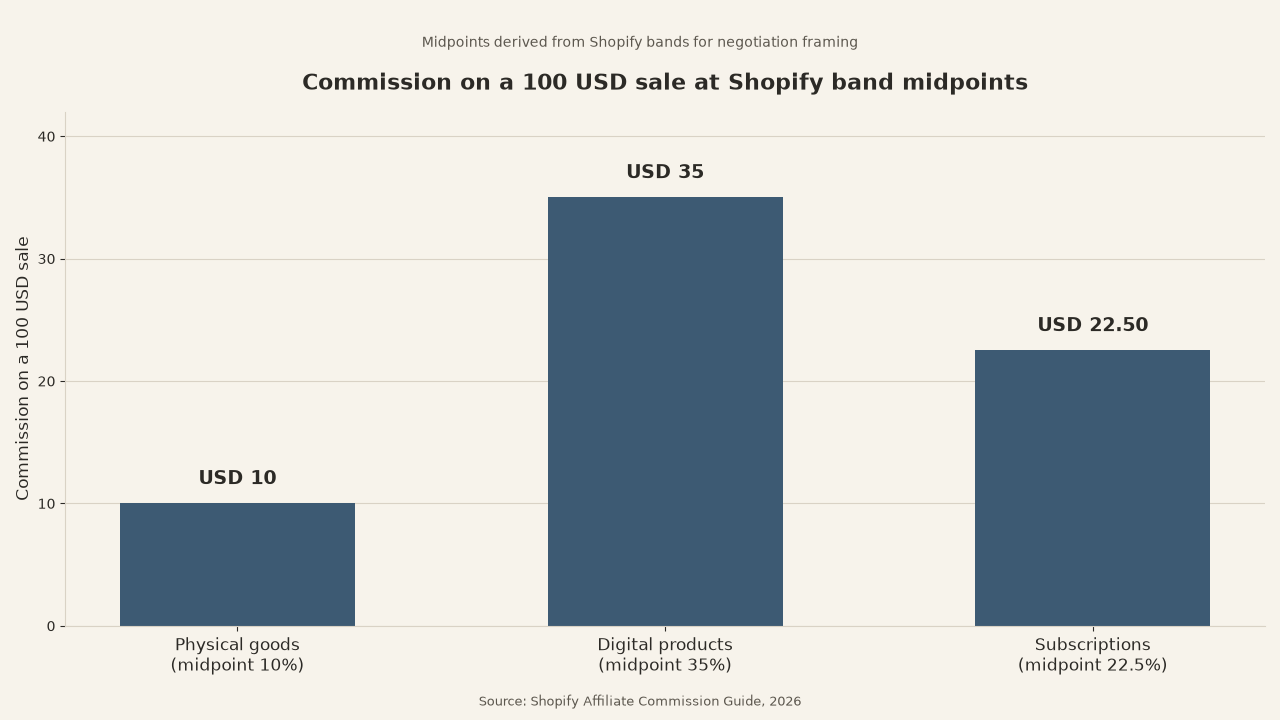
Source: Midpoints derived from Shopify Affiliate Commission Guide bands (2026). https://www.shopify.com/blog/affiliate-commission
Affiliate proof pack:
Merchant yes-rule:
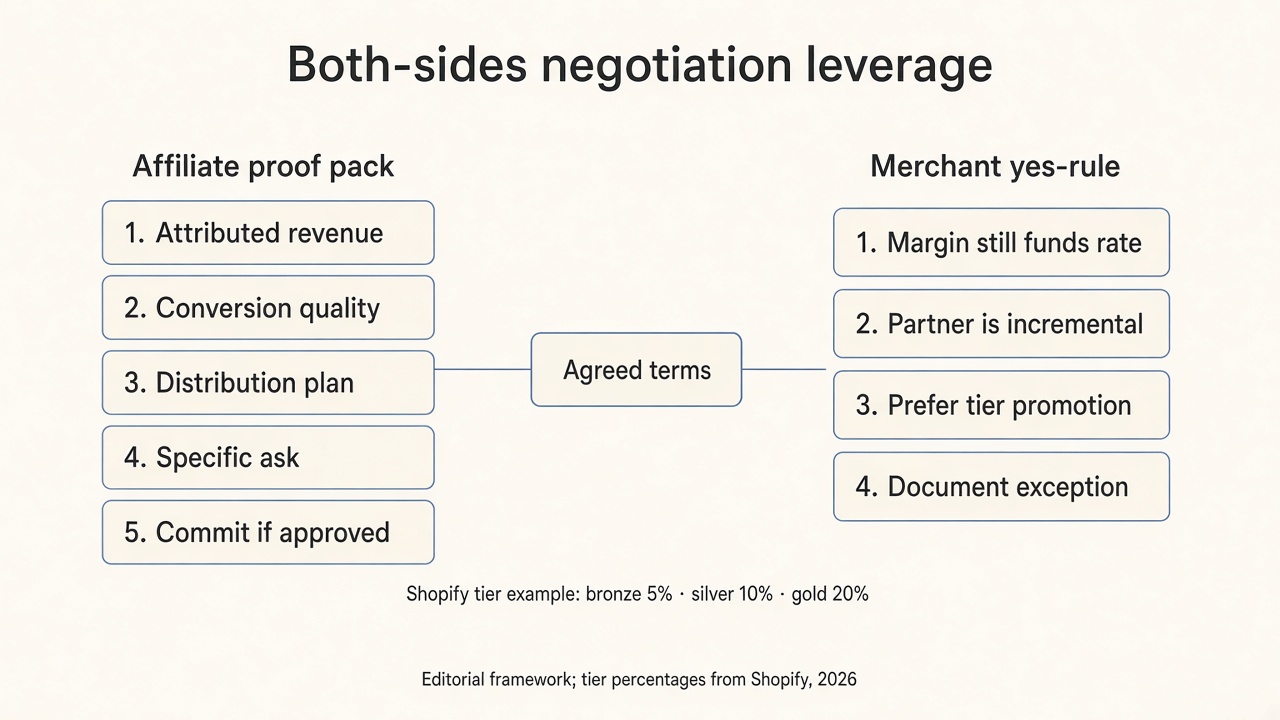
Source: Editorial framework for this article; tier example percentages from Shopify (2026).
Weak: “Can you raise my commission?”
Strong: “Over the last 90 days I drove $X attributed revenue at a 25% CPS rate on your digital SKU. I am proposing 35% (inside Shopify’s published 20%-50% digital band) for the next launch window, tied to two email sends and a dedicated review update.”
Keep the jump modest relative to the band. Moving from the floor toward the midpoint is easier than leaping to the ceiling on first ask. If you need a temporary spike, propose a trial window or a first-month subscription kicker rather than a permanent base change (Shopify on first-month subscription commissions).
Sometimes the merchant cannot raise the headline rate. Expand the deal:
| Tradeable | Why it can be worth more than +2 points | Watch-out |
|---|---|---|
| Longer attribution / cookie window | Captures delayed buyers on evergreen content | Fraud and multi-touch disputes |
| Shorter payout hold | Improves affiliate cash flow (holds often 30-60 days) | Return clawbacks hit harder |
| Exclusive code or preferred placement | Raises conversion and mindshare | Coupons can train discount seekers |
| Hybrid CPA + revshare | Pays early effort and long-term quality | Needs clean event definitions (structures guide) |
| Recurring share vs one-time | Aligns with subscription LTV | Must match churn reality |
| Creative / co-branded storefront support | Raises conversion without raising % | Still needs FTC disclosure |
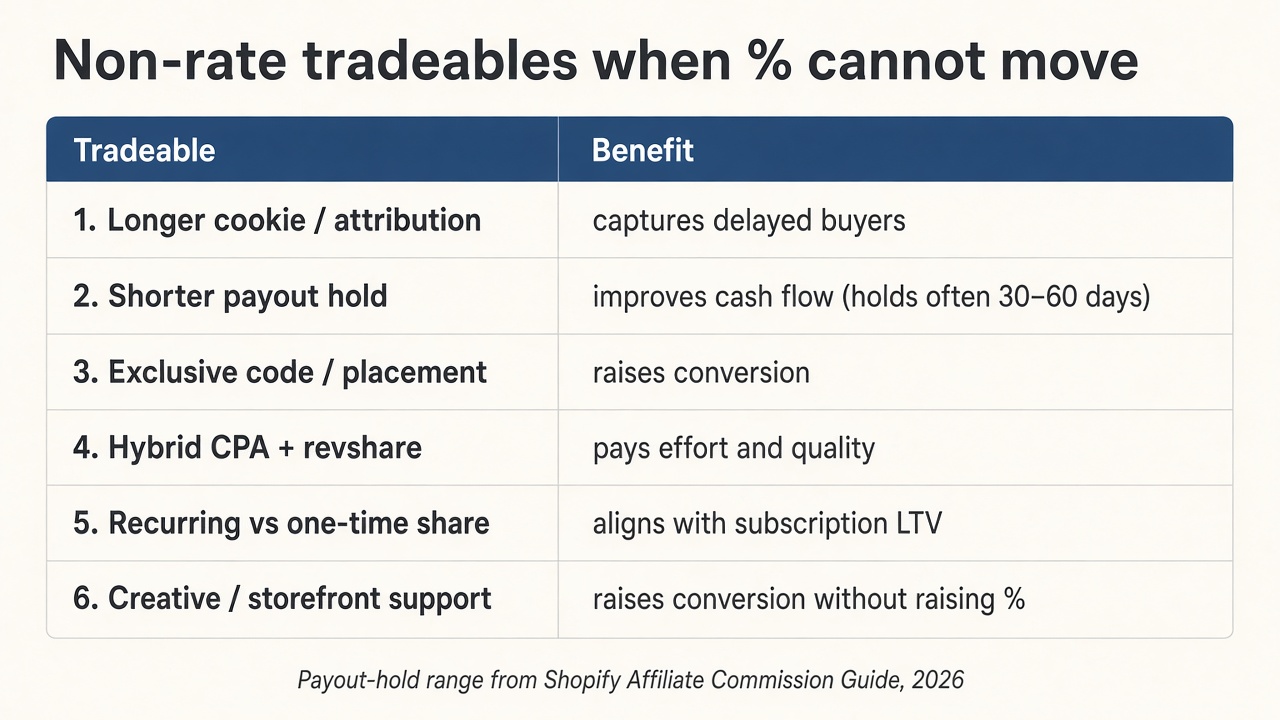
Source: Editorial matrix; payout-hold range from Shopify Affiliate Commission Guide (2026). https://www.shopify.com/blog/affiliate-commission
Get the new rate, SKUs, window, and clawback rules in the affiliate portal or email. Then update public disclosures if your content implies a material connection (it does). A higher commission does not change the FTC duty to disclose (disclosure rules).
Use a short sequence so neither side improvises under pressure.
Common failure modes: asking before any sales exist; threatening to leave without a plan; raising every partner’s rate because one creator complained; ignoring refund holds; treating Amazon Associates floors as if they were DTC program ceilings.
Q: Can you negotiate affiliate commission rates on most programs? A: Often yes with a human program manager, especially when you already drive volume or bring a concrete promotion plan. Community operators and managers describe custom tiers and one-off raises as normal, while low-margin categories stay rigid. There is no public success-rate dataset for asks.
Q: How much higher should I ask when negotiating affiliate commissions? A: Stay inside the published category band for your product type. Shopify’s digital band is 20%-50% and physical is 5%-15% (Shopify). Moving toward the midpoint or into the next published tier is usually more realistic than doubling overnight.
Q: What should I include in an affiliate commission increase email? A: Who you are, attributed revenue and timeframe, the specific new rate or tier, why it still fits margin, and what extra promotion you will deliver if approved. Offer a trial window if a permanent change is hard to approve.
Q: What if the brand will not raise the percentage? A: Negotiate non-rate terms: longer attribution window, shorter payout hold, exclusive code, hybrid CPA plus revshare, or recurring share on subscriptions. Those can raise effective earnings without changing the headline CPS rate.
Q: Should merchants publish tiers instead of negotiating every rate? A: Yes for scale. A clear bronze / silver / gold ladder (Shopify’s example uses 5% / 10% / 20%) turns many one-off asks into promotions you can explain and audit (Shopify). Reserve custom deals for partners whose volume or placement truly breaks the template.
How to negotiate affiliate commission rates is a margin conversation wearing a manners problem. Anchors live in published category bands. Proof beats vibes. Tiers beat endless exceptions. When the percentage cannot move, trade the terms that change cash timing and conversion. Default rates recruit. Negotiated rates retain the partners who actually sell.
If you are a merchant who wants tracked partners and clear split logic without spreadsheet chaos, start at https://www.feat.press.
Affiliate marketing for startups is an operating system—locks, cost, recruit, rates, tracking, first 100 sales, then diagnose a flat roster.
How to track affiliate sales: pick link cookie, coupon, pixel, S2S postback, or storefront checkout—then match Rewardful, Tapfiliate, or Impact.
Best affiliate programs for SaaS companies pass the Recurring Cap Test: labeled duration, cookie, seat type, payout rails—plus Rewardful’s ~24% planning band.