Affiliate Marketing for Startups: Complete Guide
Affiliate marketing for startups is an operating system—locks, cost, recruit, rates, tracking, first 100 sales, then diagnose a flat roster.
Sub-affiliate and multi-tier programs explained: additive override math, SubID vs recruit, and FTC sales-vs-recruitment guidance.

TL;DR: Sub-affiliate and multi-tier programs pay a recruiter an override when someone they recruited sells. That override is an additive merchant cost, not a cut of the seller’s check. Cap depth at two tiers, keep pay tied to retail sales, and never confuse SubID tracking parameters with a human sub-affiliate.
Founders hear “two-tier” and picture free recruiting. What they actually buy is a second payout line on every sale the recruit closes.
Sub-affiliate and multi-tier programs explained clearly: a selling affiliate earns the base commission; a recruiter (upline) earns an override when that sale happens. The override does not come out of the seller’s pocket. It comes out of yours. Pair this with affiliate commission structures for event types (CPS, CPA, RevShare), and with how affiliate marketing works for the single-tier path most programs should stay on.
Key takeaways:
A sub-affiliate program is an affiliate structure where one partner can recruit another, and the recruiter earns a commission override when the recruit generates a qualifying sale.
In plain language: you pay for selling, and you also pay for recruiting sellers who sell. Multi-tier programs extend that override chain past one recruit level (level 3, level 4, and so on). Two-tier is the common shallow form: merchant, recruiting affiliate, selling affiliate.
Three ideas people smash together that are not the same:
Amazon Associates is a useful contrast, not a two-tier template. The program pays on qualifying purchases driven by your traffic. It is purchase attribution, not a recruit-an-affiliate hierarchy (Amazon Associates; policies). Community threads that treat Amazon as “two-tier” are mixing concepts. Refuse that myth.
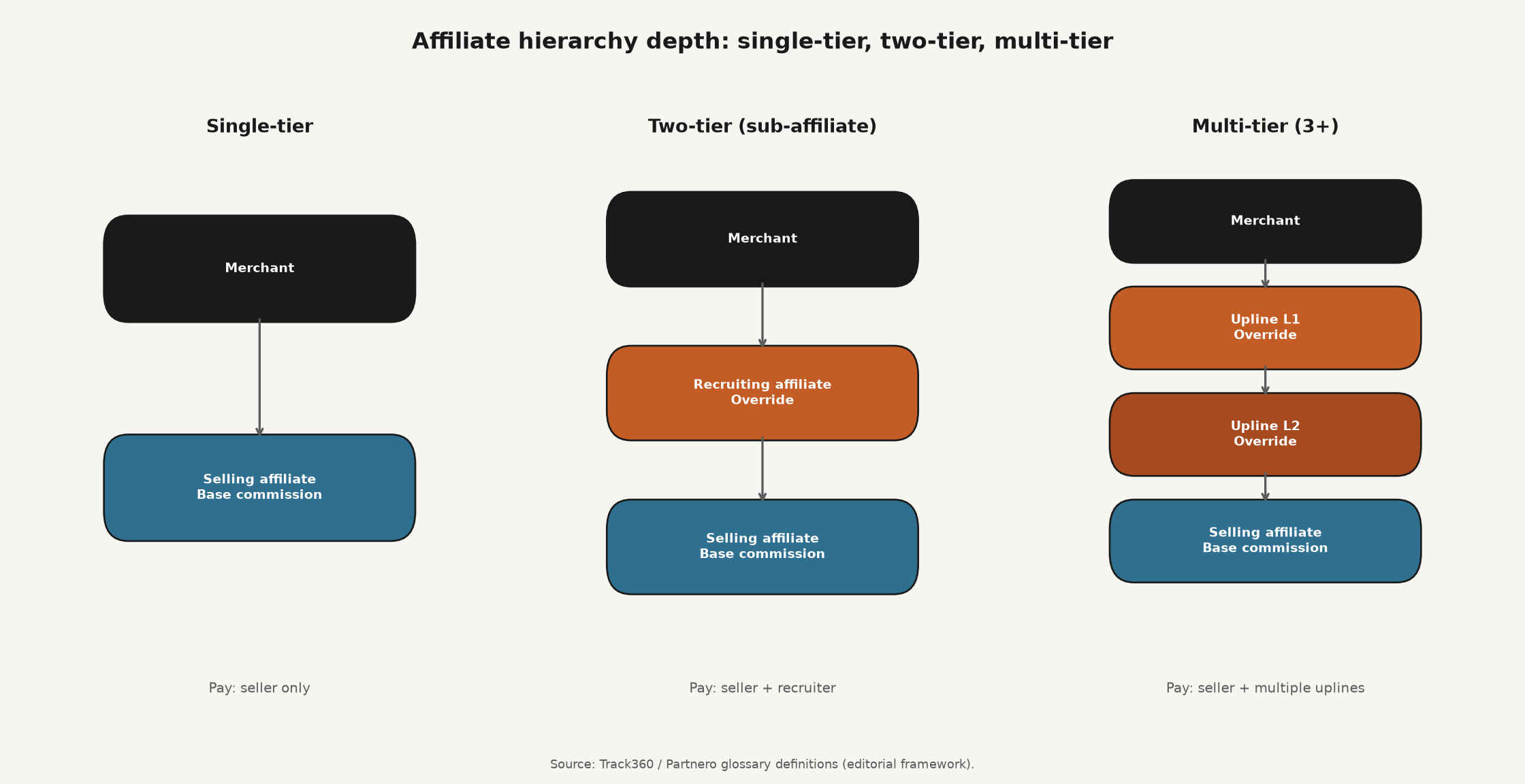
Source: Editorial hierarchy from Track360 and Partnero glossary definitions. https://track360.io/glossary/sub-affiliate-vs-multi-tier
Hierarchy is not free distribution. It is a second incentive system that either recruits real sellers or recruits people who only recruit.
Why the structure matters for merchants:
There is no public dataset that proves multi-tier programs lift GMV by a universal Y%. Anyone selling that number without methodology is selling a story.
A two-tier program works by paying a base commission to the selling affiliate and an additive override to their recruiter when a qualifying retail sale clears. Depth, override base (percent of commission vs percent of sale), and whether pay rides sales or signups decide whether you have a partner channel or a recruitment machine.
| Structure | Who earns on a sale | Depth | Typical merchant use | Main risk |
|---|---|---|---|---|
| Single-tier | Selling affiliate only | 1 | Default for most brand and marketplace programs | Partner supply may stay thin |
| Two-tier (sub-affiliate) | Seller + recruiter override | 2 | Recruiting partners who can train peers | Additive margin; self-referral abuse |
| Multi-tier | Seller + multiple upline overrides | 3+ | Rare for honest merchant programs; common in MLM-shaped pitches | Pyramid-incentive optics; unreadable margin |
Vendor glossaries treat sub-affiliate as the two-level case and multi-tier as deeper chains (Track360; Partnero). Track360’s learn guide recommends keeping multi-tier to two tiers max for most operators (Track360 learn). That matches founder instinct: if you cannot explain the third tier’s job in one sentence, delete it.
Use this as a whiteboard, not as industry averages. There is no public dataset for a universal override rate.
Assume:
If instead the override were 10% of the sale ($10), total partner cost jumps to $30. Same word “10%,” different base. Write the base into the contract.
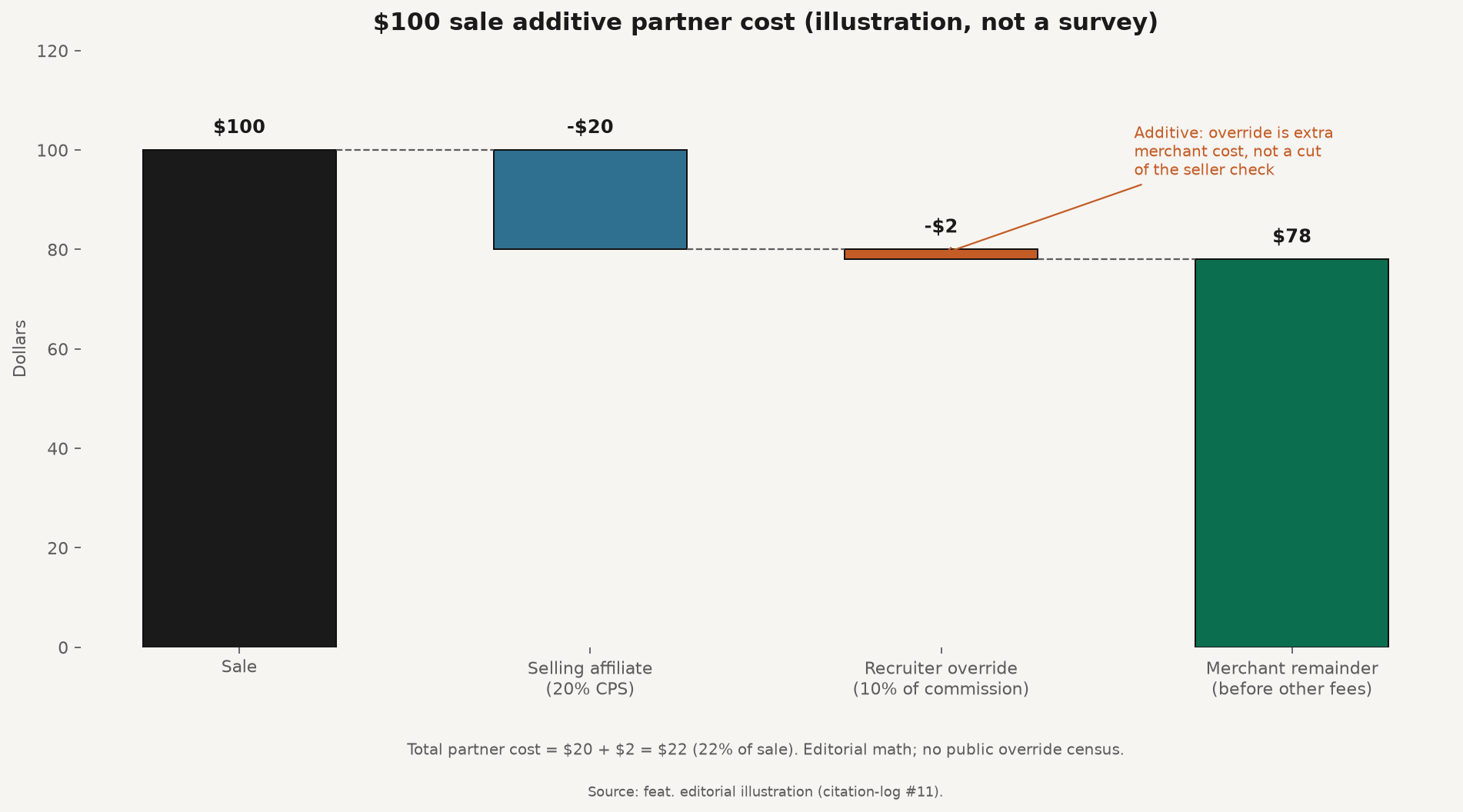
Source: feat. editorial illustration (not a survey). Override labeled as 10% of seller commission. no public dataset for average override.
Compare that to single-tier at 20%: you pay $20. The two-tier design costs $2 more per identical sale in this illustration. That $2 is the price of the recruiting incentive. Ask whether the recruit would have joined without it, and whether their lifetime attributed gross margin covers it after refunds.
For digital products with higher CPS bands, the additive override hurts more in absolute dollars. See digital product affiliate marketing vs physical goods for category band context. For how a collaborative dollar already splits among merchant, affiliate, and rails without hierarchy, see revenue split models for collaborative selling.
SubID (sometimes sid, sub_id, or nested s1/s2 fields) tags a click or conversion with campaign metadata so the affiliate can optimize sources. A sub-affiliate is a human (or entity) enrolled under another affiliate in your program tree.
Ops failures from the mixup:
Keep two columns in reporting: affiliate_id / parent_affiliate_id for hierarchy, and sub_id for traffic tags (AffBuddy).
Major consumer networks largely stepped back from loud two-tier marketing, per community discussion (Reddit). Some platforms still support revenue splits among parties. ClickBank’s Joint Venture guidelines note sellers may split transaction revenues with up to five other parties, affiliates may split commissions, and Affiliate Referral / JV contracts exist, with a hard edge: CPA fixed commissions are not eligible to split in Traditional JV or Affiliate Referral Contracts (ClickBank, updated March 31, 2025). That is not a blank check for five-deep recruiting trees. It is evidence that multiparty splits remain a product feature in parts of the info-product economy.
The FTC’s Business Guidance Concerning Multi-Level Marketing defines the typical MLM as distributing products through a network of participants who recruit downlines, with upline and downline relationships inside the plan (FTC). The legality question is not “did you use the word affiliate.” It is what the compensation plan rewards.
FTC guidance (including BurnLounge lineage discussion in the business guidance) focuses on whether the plan incentivizes promoting the opportunity over selling products to ultimate users. Courts examine both the written structure and how it works in practice (FTC).
Founder translation for a merchant affiliate program:
| Constraint | Prefer | Avoid |
|---|---|---|
| Partner supply is the bottleneck; you have trainers who can onboard peers | Two-tier with override on retail sales only | Paying for signups of inactive recruits |
| Margin is thin (physical goods, paid ads already eating CAC) | Single-tier; raise base rate for top partners instead (negotiate rates) | Multi-tier depth |
| Offer is digital with high CPS already | Single-tier or tiny override capped in dollars | Open-ended % of sale overrides stacked deep |
| Legal/compliance team flags MLM optics | Single-tier + referral bounty paid once for an activated seller | Deep hierarchy with rank titles |
| You only need campaign tagging | SubID parameters | Calling SubIDs “sub-affiliates” |
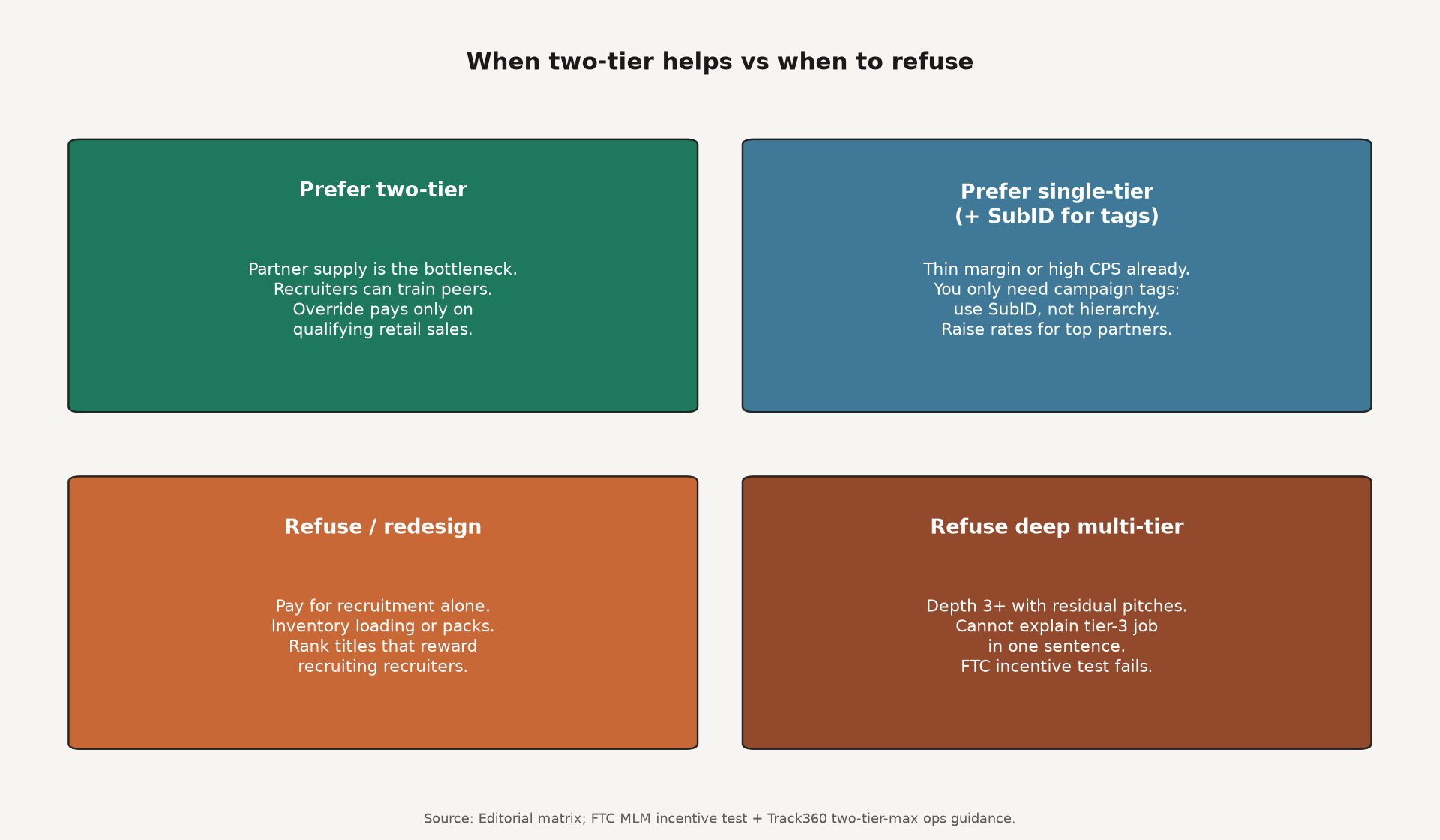
Source: Editorial decision matrix synthesizing FTC MLM incentive test and Track360 two-tier-max ops guidance. https://www.ftc.gov/business-guidance/resources/business-guidance-concerning-multi-level-marketing
Decide with margin math and incentive design, not with a “passive income for affiliates” slide. Run these steps before you flip the hierarchy switch.
Q: What is a sub-affiliate in affiliate marketing? A: A sub-affiliate is a partner recruited by another affiliate so that the recruiter earns an override when the recruit generates a qualifying sale. It is a person (or entity) in a hierarchy, not a tracking parameter. Two-tier programs are the common form of this structure.
Q: How does a two-tier affiliate program work? A: The selling affiliate earns the base commission on the sale. Their recruiter earns a separate override defined in the contract, typically framed by vendors as about 5-15% of the sub-affiliate’s earnings. That override is an additive merchant cost. Model both lines before launch.
Q: Is SubID the same as a sub-affiliate? A: No. SubID is a tracking field used to tag campaigns or traffic sources. A sub-affiliate is a recruit in a multi-level partner tree. Confusing them produces wrong payouts and wrong compliance conversations.
Q: Are multi-tier affiliate programs legal? A: Paying performance commissions on retail sales, including shallow overrides, is a normal commercial tool when designed carefully. Pyramid risk rises when compensation incentivizes recruitment over selling products to ultimate users, which is the FTC’s focus in its MLM business guidance. Depth, inventory loading, and pay-for-signup designs raise risk. This is not legal advice.
Q: Do two-tier affiliate programs still exist? A: Yes, but they are less loudly advertised by major networks than in earlier affiliate eras. Community discussion in 2026 describes niche, private, and JV-style setups (including ClickBank-style splits) more often than network homepage banners. Treat that as market color, not a volume study.
Sub-affiliate and multi-tier programs are recruiting incentives layered on top of retail commissions. The override is additive. SubID is unrelated. Two tiers is enough for almost every merchant job, and FTC guidance draws the line at whether you reward selling to customers or selling the opportunity.
If you want partners selling through co-branded storefronts with a clear revenue split on every sale, start at feat. and design the economics before you add hierarchy.
Affiliate marketing for startups is an operating system—locks, cost, recruit, rates, tracking, first 100 sales, then diagnose a flat roster.
How to track affiliate sales: pick link cookie, coupon, pixel, S2S postback, or storefront checkout—then match Rewardful, Tapfiliate, or Impact.
Best affiliate programs for SaaS companies pass the Recurring Cap Test: labeled duration, cookie, seat type, payout rails—plus Rewardful’s ~24% planning band.