Affiliate Marketing for Startups: Complete Guide
Affiliate marketing for startups is an operating system—locks, cost, recruit, rates, tracking, first 100 sales, then diagnose a flat roster.
PartnerStack vs Impact for B2B affiliates: job-fit fork, Network Report (+112% paid customers, 14× earners), and live pricing caveats.

TL;DR: PartnerStack vs Impact for B2B affiliates is a job-fit choice, not a sticker-price bake-off. PartnerStack fits B2B SaaS affiliate, referral, and co-sell motions with a Network marketplace (vendor-stated 135,000+ partners) and 2025 Network proof (+112% paid customers, ~14× Network earners). Impact fits horizontal partnership ops across affiliates, creators, and referrals. Live public fee cards are thinner than listicles admit.
Founders shortlist PartnerStack and Impact because both run partner programs. Then the spreadsheet dies. One side has no public dollars. The other side’s pricing URL may not even serve a price list when you hit it. Feature matrices paper over the real fork: what partner motion are you buying?
PartnerStack vs Impact for B2B affiliates matters when you are about to sign a PRM or partnership cloud for software, not when you want another logo roundup. This page sits next to best affiliate marketing platforms, SaaS affiliate commission rates, how to recruit affiliates for SaaS, and recurring vs one-time affiliate commissions.
impact.com/pricing/ returns HTTP 302 to /get-started/, so treat widely cited Impact tier dollars as dated secondary reporting, not a live primary card.PartnerStack vs Impact for B2B affiliates is a comparison of two partnership platforms SaaS teams shortlist for recruiting and paying partners: PartnerStack as a B2B SaaS-native partner ecosystem with marketplace recruitment, and Impact (impact.com) as a horizontal partnership management cloud built to run affiliates, creators, and referrals together.
They are not interchangeable “affiliate trackers.” PartnerStack markets affiliate, referral, co-sell, and B2B influencer motions inside one PRM aimed at software vendors, with a Marketplace that claims 135,000+ active partners across 600+ SaaS companies (PartnerStack platform). Impact’s homepage sells a unified affiliate + creator + referral stack “powered by $100B+ in partnership commerce” (impact.com).
Community language tracks that fork. On r/Affiliatemarketing, operators call Impact “enterprise grade… overkill before” serious partner volume, and PartnerStack “SaaS focused,” poorly matched to influencer-ecommerce hybrids (r/Affiliatemarketing). On r/OpenPartner, Impact is framed as the wrong shape for many SaaS programs under roughly 1,000 partners (r/OpenPartner). Those threads are vernacular. They are not pricing tables.
This article owns the head-to-head for B2B affiliate and partner ops. The wider field map (Amazon, Awin, CJ, storefronts) lives on best affiliate marketing platforms. Ecommerce app seats like UpPromote live on Shopify affiliate apps compared.
Wrong platform choice taxes the wrong team for years. A SaaS founder who buys a commerce-first partnership cloud pays for surfaces they never use. A multi-brand retailer who buys a SaaS marketplace seat hunts the wrong partners.
/pricing/ path redirected to get-started on our check date. Budget work that depends on a scraped listicle card is already wrong.PartnerStack vs Impact works when you name the partner motion first, then the recruitment surface, then the ops stack, and only then the fee conversation. PartnerStack is the B2B SaaS ecosystem bet: Marketplace discovery, recurring-friendly partner payments, CRM-shaped workflows. Impact is the horizontal partnership cloud bet: affiliates, creators, and referrals under one commerce-grade measurement story. Price cards, when they exist, are inputs after that fork, not the fork itself.
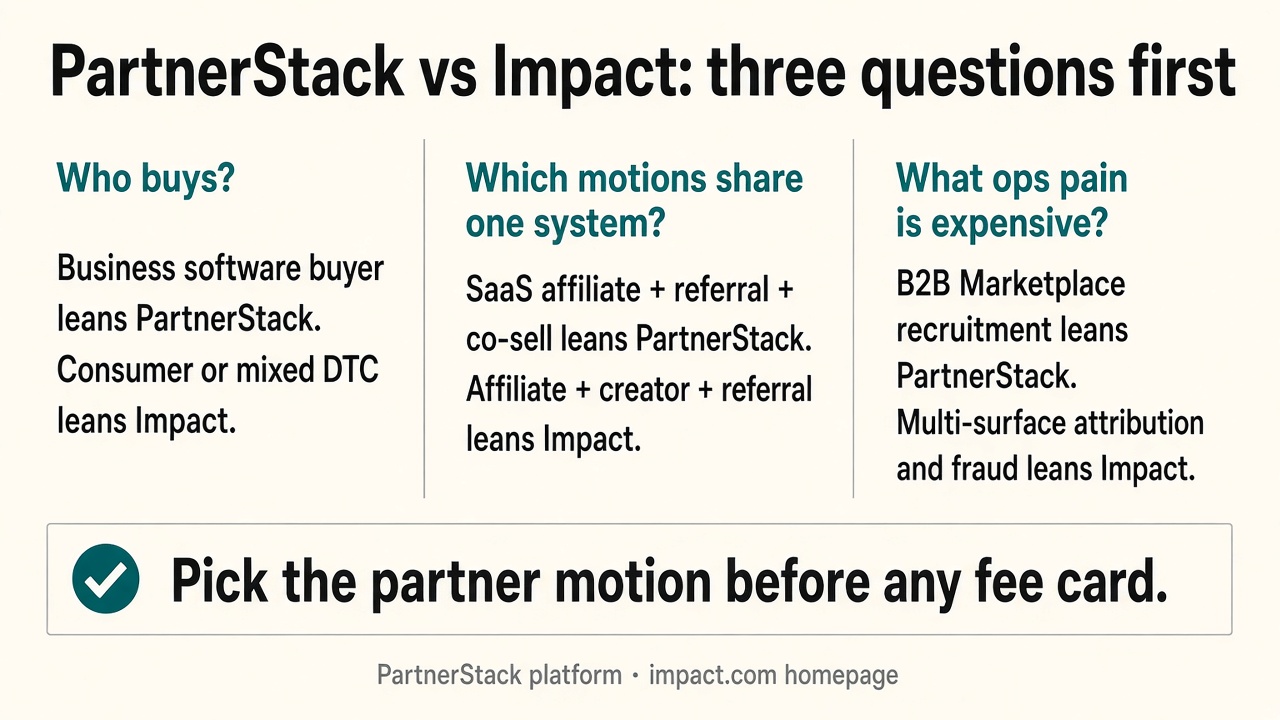
Source: feat. editorial job-fit framework synthesizing PartnerStack B2B SaaS positioning and impact.com unified partnership positioning, 2026. https://partnerstack.com/platform/partnerships-software · https://impact.com/
Ask these in order.
PartnerStack’s platform page claims 135,000+ active partners and 600+ SaaS companies; Marketplace listing copy also cites 116K+ discovery reach on the same property, so treat the count as a vendor-stated band, not a third-party census (PartnerStack platform).
The February 2026 Network Report is the citation-grade performance stack:
| Metric (PartnerStack Network Report) | Figure | Why it matters |
|---|---|---|
| All-time GMV milestone | $2.7B | Scale of software sales through the Network |
| Transaction volume YoY (2025) | +52% | Channel growth, not just roster growth |
| Paid customer signups YoY | +112% | Intent over traffic |
| Active partner earnings YoY | +19% | Partner productivity |
| Network vs non-Network earners | ~14× / 43% vs 3% | Recruitment quality filter |
| Top-25 vendor best offers | 20% / 25% / 30% | Commission planning band |
Source: PartnerStack Research Lab, Feb 2026; earner percentages also on the May 2024 Network chart.
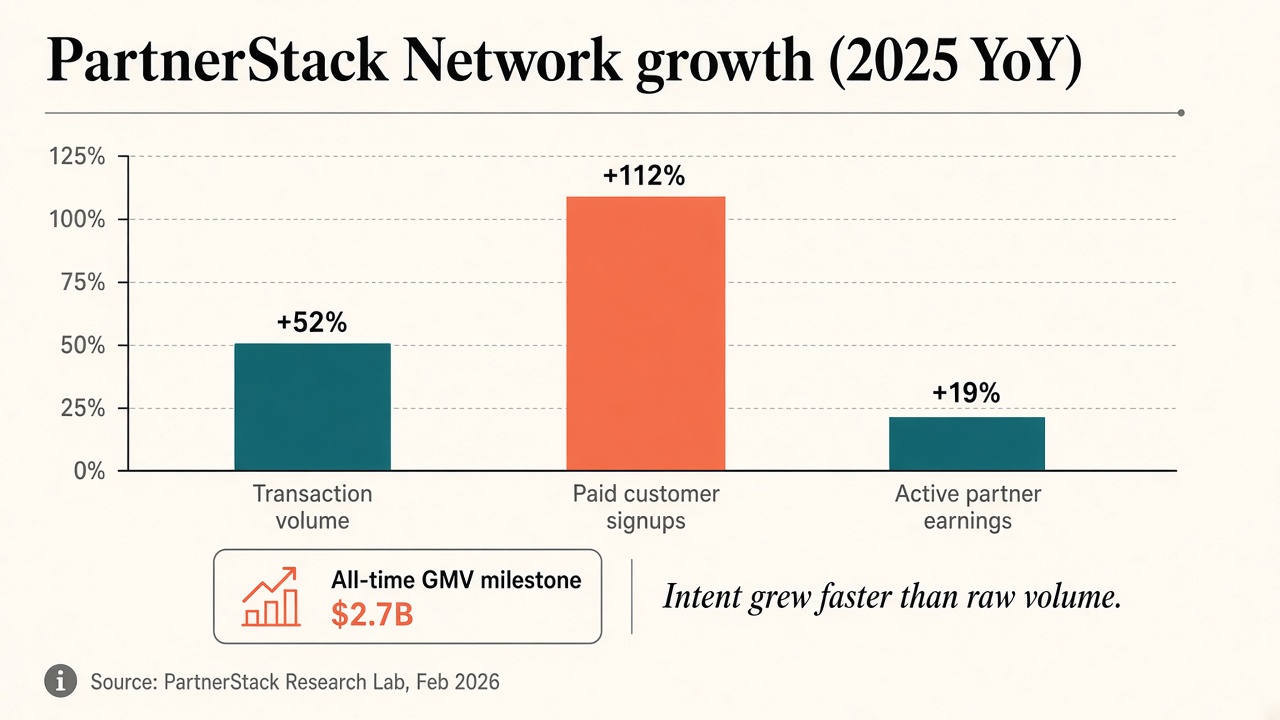
Source: PartnerStack Research Lab, PartnerStack is Scaling Revenue Precision in 2026 (February 2026). https://partnerstack.com/resources/research-lab/report-partnerstack-is-scaling-revenue-precision-in-2026
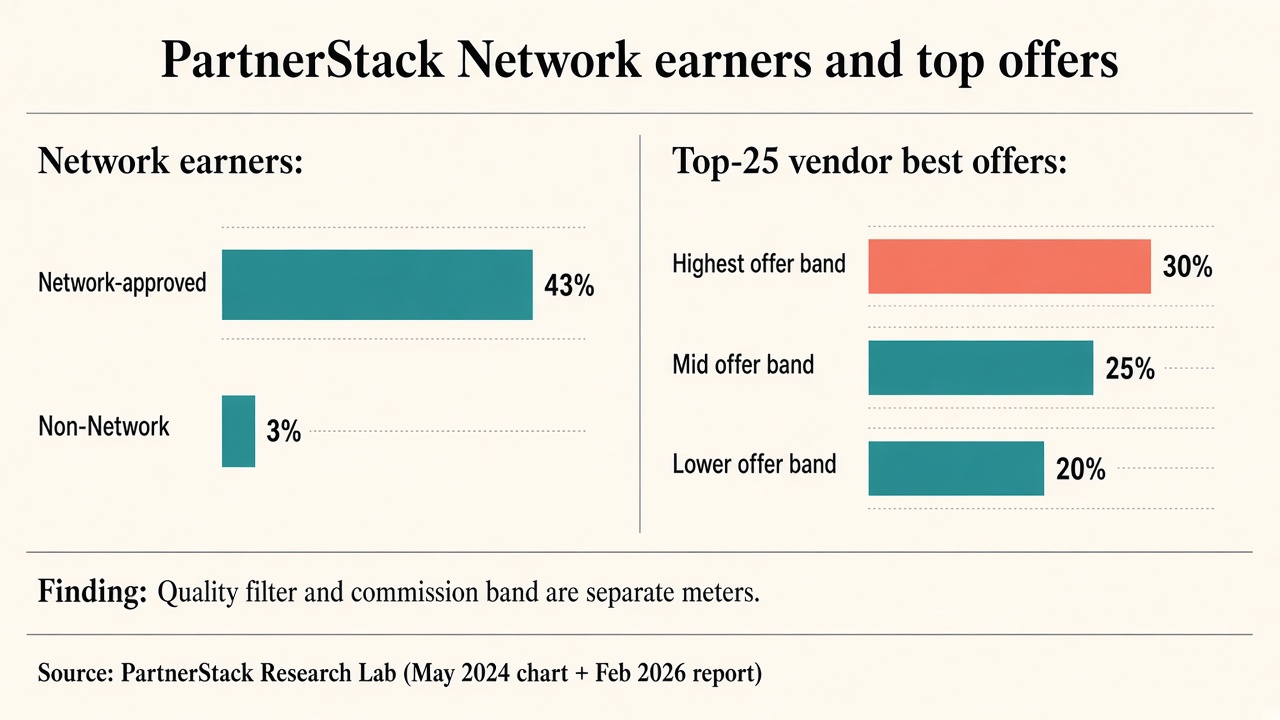
Source: PartnerStack Research Lab Network earners chart (May 2024) and February 2026 Network Report top-25 vendor offers. https://partnerstack.com/resources/research-lab/charts/partnerstack-network-approved-partners-are-far-more-likely-to-earn-a-commission-compared-to-non-network-partners · https://partnerstack.com/resources/research-lab/report-partnerstack-is-scaling-revenue-precision-in-2026
Recruitment still fails if you treat Marketplace join as strategy. Pair this page with the five-bucket outbound stack in how to recruit affiliates for SaaS. Rewardful’s 1.28% sale activation is the dormancy constraint every seat inherits (Rewardful).
Impact’s own homepage argument is unification: affiliates, creators, and referrals on one performance platform, with a $100B+ partnership-commerce claim (impact.com). That is a different product thesis than “B2B SaaS Marketplace.” Brands that already run coupon publishers, creators, and customer referral next to software affiliates often need that breadth more than they need a SaaS-only discovery pool.
Impact also tends to win the conversation when operators care about enterprise-grade tracking, compliance, and fraud surfaces. Community threads repeatedly call that stack heavy for small SaaS rosters (r/Affiliatemarketing; r/OpenPartner). Heavy is not bad. Heavy is expensive when your partner count is eighty and your motion is Stripe-recurring only.
| Question | PartnerStack (primary) | Impact (live primary check) |
|---|---|---|
| Public tier names | Launch, Growth, Enterprise | Marketing frames product lines; /pricing/ redirected to get-started on check date |
| Public dollar subscription | Not published; demo-confirmed (pricing) | Live primary dollars not served at /pricing/ (HTTP 302 → /get-started/) |
| Dated secondary fee ladder | N/A | Affmaven (May 2026) and Rework (Aug 2026) reported Starter from $30/mo, Essentials from $500/mo, Pro from $2,500/mo, plus 2.5% on partner-driven transactions (Affmaven; Rework) |
| Self-serve signup story | Demo-gated | Secondary sources describe Starter self-serve historically; verify live before budgeting |
| Operator dollar anecdotes | Reddit-style $1K–$5K/mo bands exist | Reddit-style “six figures / year” bands exist |
Label every secondary dollar figure. Do not chart Impact tier prices as live primary while /pricing/ redirects. Do not promote Reddit PartnerStack bands as a census (no public dataset).
Illustrative Impact fee math from secondary sources (not a vendor quote): at $50,000/mo partner-driven revenue, a 2.5% fee is $1,250/mo before subscription. That pattern is why transaction fees dominate at scale when they exist. Confirm the live contract terms in writing.
| Dimension | Prefer PartnerStack | Prefer Impact |
|---|---|---|
| End customer | B2B software buyers | Consumer / DTC / mixed commerce, or B2B plus heavy creator mix |
| Core motions | Affiliate + referral + co-sell in a SaaS PRM | Affiliate + creator + referral unification |
| Recruitment | Marketplace / Network of B2B partners (135,000+ vendor claim) | Broad partnership discovery; commerce and creator depth |
| Proof stack you can cite today | Network Report: $2.7B GMV, +112% paid customers, 43% vs 3% earners | Homepage $100B+ partnership commerce positioning + brand case stories |
| Pricing research path | Demo required (pricing) | Do not trust stale listicle cards; confirm live quote (pricing URL redirected on 2026-09-29) |
| Likely overkill signal | You only need Stripe-native link tracking for <50 affiliates | You only need SaaS Marketplace recruitment with no creator/commerce surface |
Choose by motion, then verify fees in writing, then run a recruitment sprint against activation math. Do not start from a scraped price card.
Q: Which is better for B2B SaaS affiliates, PartnerStack or Impact? A: PartnerStack is usually the better default when your buyers are businesses and you need Marketplace-sourced software partners, recurring-friendly payouts, and SaaS PRM workflows. Impact is stronger when affiliates, creators, and referrals must share one horizontal partnership platform. Confirm fees in a live quote either way.
Q: How much does PartnerStack cost compared to Impact?
A: PartnerStack does not publish dollar prices; Launch / Growth / Enterprise pricing is demo-confirmed (PartnerStack pricing). Impact’s /pricing/ URL redirected to get-started on September 29, 2026, so treat older $30 / $500 / $2,500 + 2.5% writeups as dated secondary reports, not a live card.
Q: Does PartnerStack’s marketplace beat Impact for SaaS recruitment? A: For B2B software partners, PartnerStack’s Network is the stronger public proof stack: vendor-stated 135,000+ partners and Network earners at 43% vs 3% outside the Network. Impact’s strength is breadth across partnership types, not a SaaS-only marketplace census.
Q: What commission rate should I offer on either platform? A: Plan near PartnerStack’s top-vendor 20% / 25% / 30% offers and Rewardful’s 24.16% average across 2,847 programs. Rate alone does not fix dormancy when only 1.28% of affiliates generate a sale.
Q: Can a small SaaS team skip both and use a lighter tracker? A: Yes, if you only need Stripe-native tracking for a small roster and will recruit manually. PartnerStack and Impact earn their keep when marketplace recruitment, multi-motion partners, or enterprise ops become the bottleneck. Lighter tools are not covered as equals on this page.
PartnerStack vs Impact for B2B affiliates is a motion decision. PartnerStack owns the B2B SaaS ecosystem story with Network Report proof ($2.7B GMV, +112% paid customers, 43% vs 3% earners, 20 / 25 / 30 offers). Impact owns the horizontal partnership cloud for affiliates, creators, and referrals. Price cards are secondary, and some of them are already stale. List on feat. when builders need co-branded affiliate storefronts alongside, or instead of, a classic network seat.
Affiliate marketing for startups is an operating system—locks, cost, recruit, rates, tracking, first 100 sales, then diagnose a flat roster.
How to track affiliate sales: pick link cookie, coupon, pixel, S2S postback, or storefront checkout—then match Rewardful, Tapfiliate, or Impact.
Best affiliate programs for SaaS companies pass the Recurring Cap Test: labeled duration, cookie, seat type, payout rails—plus Rewardful’s ~24% planning band.