Affiliate Marketing for Startups: Complete Guide
Affiliate marketing for startups is an operating system—locks, cost, recruit, rates, tracking, first 100 sales, then diagnose a flat roster.
How to build a sales team without hiring salespeople: founder, customers, creators on storefronts, 1099 reps, agencies. Costs and classification risk.

TL;DR: You can build a sales team without hiring salespeople by borrowing five seats: yourself, your customers, creators and affiliates selling from co-branded storefronts, commission-only contractors, and outsourced SDR agencies. Pay the first three only on closed sales. Treat commission-only reps carefully, because a rep you direct may legally be an employee. Hire once the motion repeats.
Founders who want to build a sales team without hiring salespeople usually have the same problem: the product works, the pipeline is them, and a sales hire costs money they would rather spend on product. Most advice answers with “do founder-led sales and buy some tools.” That is half right. It leaves out the people who already sell for you for free.
I have evaluated 1,500+ startups and guided $24M in Seed to Series A raises. The first sales hire is one of the most common places I have watched early money disappear. Not because the rep was bad. Because the company hired someone to discover a sales motion instead of to repeat one.
A sales team without salespeople is a group of people outside your payroll who bring you paying customers, each paid by commission, reward, or fee instead of salary.
The phrase sounds like a trick. It is not. Every early company already has one: the customer who keeps sending friends, the creator who reviewed you without being asked, the consultant who recommends you to clients. What they lack is a seat. No page to send people to, no tracking, no payout. So their sales go uncounted and unpaid, and they eventually stop.
Building the team means giving each of those people a defined seat with a defined deal. Some seats are cheap and loose. Some are expensive and controlled. The Borrowed Sales Team framework below names the five.
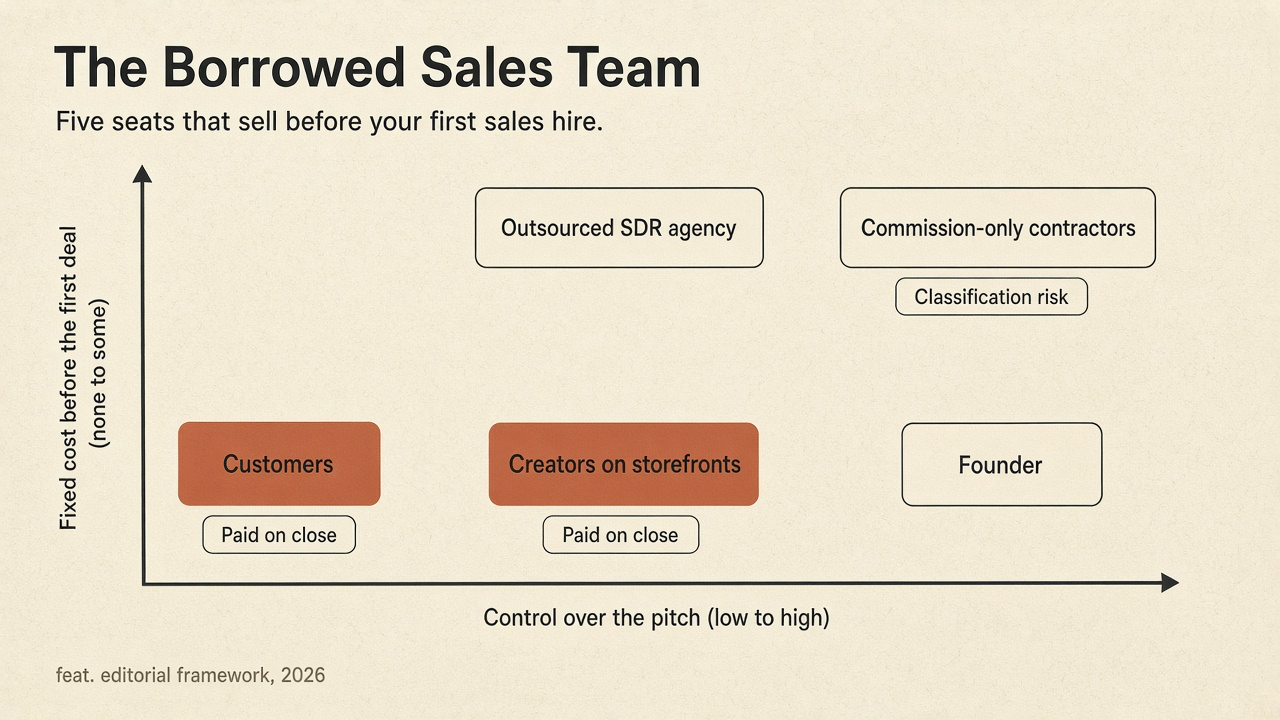
Source: feat. editorial framework, 2026. Worker classification tests: IRS, 2026. https://www.irs.gov/businesses/small-businesses-self-employed/independent-contractor-self-employed-or-employee.
Startups should borrow sellers before hiring them because a salaried rep is a fixed cost that starts before the first deal, while borrowed sellers are paid only when revenue lands. The hire makes sense once a repeatable motion exists. Before that, you are paying salary for discovery work the founder should be doing anyway.
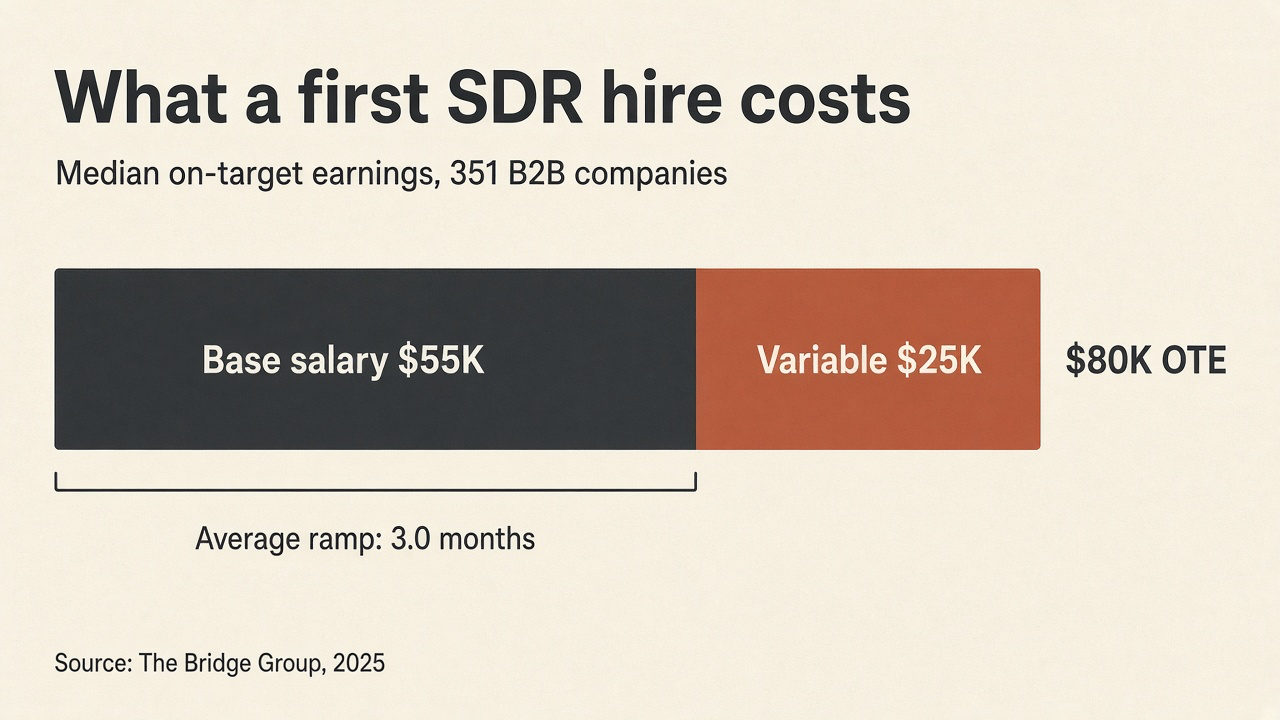
Source: The Bridge Group, 2025. https://www.bridgegroupinc.com/research/2025-sdr-models-metrics-report-the-bridge-group.
The Borrowed Sales Team works by assigning every non-employee seller one of five seats, each with its own pay rule and level of control. The founder sells and writes the playbook. Customers refer. Creators and affiliates sell from co-branded storefronts. Commission-only contractors and agencies fill gaps, with care. Pay on close wherever you can.
| Seat | Who | Fixed cost before first deal | Paid on | Control over the pitch | Classification risk |
|---|---|---|---|---|---|
| Founder | You and cofounders | Your time | Equity | Total | None |
| Customers | Happy buyers who refer | None (reward per referral) | Closed referral | Low; they use their own words | Low |
| Creators and affiliates on storefronts | People with an audience who fit the buyer | None | Closed sale, split at checkout | Medium; you set the offer and the page | Low when they promote independently to their own audience |
| Commission-only contractors | Freelance closers or appointment setters | Low; onboarding time | Closed deal or booked meeting | High; you script and direct them | High if you direct the work and it is your core business |
| Outsourced SDR agency | A firm that runs outbound for you | Retainer, quote-based | Fee, often plus meetings | Medium; their reps, your messaging | Low (vendor contract) |
Sources: IRS common-law rules, 2026. California LWDA ABC test. Bridge Group, 2025.
No one else can sell a product that has not found its pitch yet. The founder’s job in this seat is not just closing. It is writing down what closes: who buys, what objection kills a deal, what price holds. A community answer on r/startups gave the usual sequence: sell yourself, close 10 to 20 deals, learn the objections, then “recruit partners/affiliates where the audience already exists” (r/startups).
Your customers are the cheapest sellers you will ever have because they already believe you. Give them a referral reward and a link. The structure matters more than the size of the reward; see referral program benchmarks and structures for the published numbers. The limit: customers refer occasionally, to people like them. That is a channel, not a quota.
Creators and affiliates have something customers do not: an audience that is waiting for a recommendation. The common mistake is handing them a raw tracking link and hoping. Rewardful’s data across 2,847 SaaS programs shows 7.6% of affiliates ever generate a referral and 1.28% ever generate a sale (Rewardful, 2026). Vetting changes the math: PartnerStack reports 43% of its Network-approved partners earn a commission, against 3% of non-Network partners (PartnerStack).
So pick sellers by fit, then give each one a page that sells. That is what feat. does. You list the product and name the promoters, or approve affiliates who pitch your listing on the marketplace. Each approved seller gets a co-branded storefront with their handle and a trackable link. Checkout runs on Stripe and splits every sale between your net, their commission, and the platform fee, so nobody waits on a spreadsheet. feat. does not recruit sellers for you and does not guarantee sales. For how to pick the people, see how to recruit affiliates for your product. For the mechanics of the page and the split, see how to turn anyone into a seller.
Where this seat is weak: high-ticket B2B deals with long procurement cycles. Affiliates drive buyers to a page. They do not run six-week security reviews. If your product is bought on a call, keep the founder or a hire in that seat.
Commission-only arrangements can be legal, but the label “independent contractor” does not make someone one. The IRS looks at behavioral control, financial control, and the type of relationship, and says “no one factor stands alone” (IRS). If you misclassify an employee with no reasonable basis, you can be liable for the employment taxes.
States can be stricter. California’s ABC test presumes employment unless the worker is free from your control, does work “outside the usual course” of your business, and runs an independent business of their own (California LWDA). A rep whose job is selling your core product, on your script, is hard to fit through prong B. An affiliate who reviews many brands for their own audience looks different, because they run their own publishing business. This is not legal advice. Talk to employment counsel before you set up a commission-only rep.
An agency buys you outbound volume without payroll. It is a vendor contract, so classification is the vendor’s problem. Pricing is quote-based, and there is no public dataset of agency retainers we trust enough to cite. Agencies fit when your ideal customer is well defined and your message already converts. They fail when you are hoping they will figure out the message for you.
These six steps take you from founder-only selling to a borrowed team that is paid on results. Run them in order. Each step uses what the previous one taught you, and the last step tells you when to stop borrowing and hire.
Q: How can a startup build a sales team without hiring salespeople? A: Borrow five seats: the founder, customers who refer, creators and affiliates selling from co-branded storefronts, commission-only contractors, and outsourced agencies. Pay the first three only on closed sales, and hire once the pitch repeats without you.
Q: Do commission-only sales reps work for early-stage startups? A: Rarely before you have proof. Experienced reps want paying customers and a known sales cycle before they work without a base, and a rep you direct may legally be an employee under IRS or state tests.
Q: What does it cost to hire an SDR instead? A: The Bridge Group’s 2025 study puts median SDR on-target earnings at $80K ($55K base, $25K variable) with a 3.0-month ramp. Benefits, tools, recruiting, and manager time come on top.
Q: Are affiliates better than sales reps? A: For products bought on a page, such as self-serve software, apps, digital products, and memberships, affiliates on storefronts are cheaper because they are paid only on sales. For high-ticket deals closed on calls, a founder or hired rep still wins.
Q: Is an affiliate the same as a commission-only employee? A: No. An affiliate promotes independently to their own audience and is usually paid as a non-employee. A commission-only rep you script and direct to sell your core product may be an employee regardless of the contract label.
You do not need a sales payroll to have a sales team. You need seats. Sell first yourself and write down what works. Give customers a reason to refer. Give the right creators a storefront that sells and a split that pays them on every sale. Use contractors and agencies only where they fit, and respect the line between a promoter and an employee. Hire when the motion repeats. If you already know who should sell for you, list your product on feat.
Affiliate marketing for startups is an operating system—locks, cost, recruit, rates, tracking, first 100 sales, then diagnose a flat roster.
Build a commission-based sales network as a single-tier seller graph—economics, surface, named sellers, then density. Rewardful: only 1.28% of affiliates sell.
Build a product distribution network on four rails—DTC, wholesale, commission sellers, co-branded storefronts. Densify before you scale; Lowe’s pays up to 20% on storefronts.