Product Quiz Conversion Rate Benchmarks (2026)
Product quiz conversion rate benchmarks are a Quiz Denominator Ladder: RevenueHunt 5.5% of completers; ConvertFlow 5.2% of viewers. Not sitewide CVR.
Exit-intent popup benchmarks: Omnisend 2025 onExit ~1.8% vs scroll 2.1%; OptiMonk cart-abandon 17.12% is a different job. Not list-growth averages.

TL;DR: Exit intent popup conversion benchmarks are a Trigger Job Ladder, not a 10–17% take-rate slogan. Omnisend’s 2025 email-popup census puts onExit near 1.8%, below scroll (~2.1%) and page-count (~2.3%). OptiMonk’s 17.12% is cart-abandonment exit, a different job. Popupsmart’s 2026 gap (1.10% vs 0.78%) is not statistically reliable. This is not email list growth.
Merchants Google exit intent popup conversion benchmarks and get a mashup: Wisepops 3.94%, OptiMonk 17.12%, a Reddit 3.5–4.5%, then a “top 10% hit 19%” slide. Finance averages them. You fire a sitewide overlay on every mouse-out and wonder why mobile bounce spiked.
Exit intent popup conversion benchmarks matter when you decide whether the overlay is a last-chance email capture, a cart-recovery offer, or a guess on a phone with no cursor. This page sits next to email list growth benchmarks, cart abandonment rate reasons, cart abandonment rate by niche, browse abandonment email benchmarks, and mobile vs desktop conversion.
Exit intent popup conversion benchmarks are labeled accept rates for overlays that fire when software infers a visitor is about to leave — emails or phones captured per display for list growth, and accepts or recovered carts per display when the job is salvage.
They are a trigger, not a popup style. The same discount box can fire on scroll, on a timer, or on exit. Omnisend is explicit: engagement-based triggers beat onExit for email capture, and a colder signup rate does not make exit useless for cart recovery (Omnisend).
Desktop detection watches the cursor race toward the tab bar. Mobile substitutes a fast upward scroll, a back gesture, or idle time. Those are different sensors. Treating them as one “exit intent conversion rate” invents a third meter.
This article owns the Trigger Job Ladder. Email list growth owns the 2.1% display census and form-type ladder. Cart emails own the later clock.
Wrong clocks buy the wrong overlay. You interrupt browsing for a cart-recovery percentage, train people to close modals, and then blame creative.
Exit-intent conversion works when you name the job (email capture versus cart salvage), name the panel (Omnisend display census versus OptiMonk use-case versus Popupsmart reliability), and refuse to mix those rates with list-growth form types.
| Rung | What you measure | Labeled public anchor | Decision |
|---|---|---|---|
| 1. Capture trigger (Omnisend) | Emails ÷ displays by trigger | onExit ~1.8%; scroll ~2.1%; page-count ~2.3%; other ~2.9% | List growth: start with scroll or page-count |
| 2. Capture trigger (Wisepops) | Emails ÷ displays; signup popups | Exit 3.94%; scroll 5.37%; landing 4.72%; top 10% on exit 19.20% | Same direction, different methodology — do not average with rung 1 |
| 3. Reliability (Popupsmart) | Median campaign lead rate | Exit 1.10% vs 0.78% without — not statistically reliable | Test; do not mandate |
| 4. Page job | Lead rate by URL | Cart/checkout 4.57%; home 1.07% | Put salvage on cart, not homepage |
| 5. Cart-recovery use case (OptiMonk) | Converts on exit with items in cart | 17.12% cart-abandon; email no-incentive 5.10% | Different job; different conversion definition |
Sources: Omnisend 2025; Wisepops 2026; Popupsmart 2026; OptiMonk.
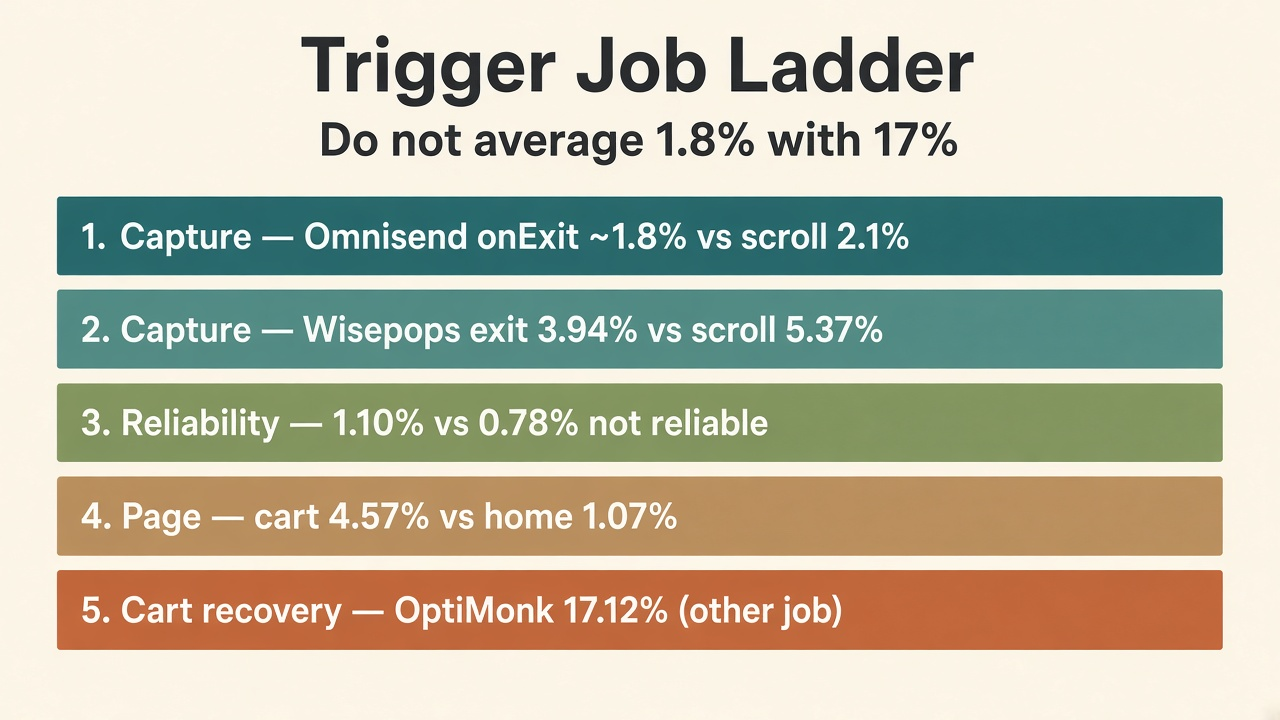
Source: Omnisend 2025; Wisepops 2026; Popupsmart 2026; OptiMonk (page dated Jun 20, 2025). URLs in the table.
Omnisend writes onExit as a last-resort capture rate on a filtered 2025 popup-platform sample (≥1,000 yearly views; drop 50%+ outliers). OptiMonk writes 17.12% as cart-abandonment popups — exit-intent shown to people who already have items in cart (OptiMonk). Flint-style roundups paste both into one “exit intent converts at 4% / cart at 17% / therefore plan 10%.” That is three jobs wearing one hat.
Wisepops’ 3.94% is closer to Omnisend in kind (signup popups, emails ÷ displays) and still ranks exit below scroll. Use it as a second labeled capture panel, not a vote that raises Omnisend to 3%. Popupsmart’s median campaign sits near 1% and says the exit gap could be chance (Popupsmart). That is the honesty rung.
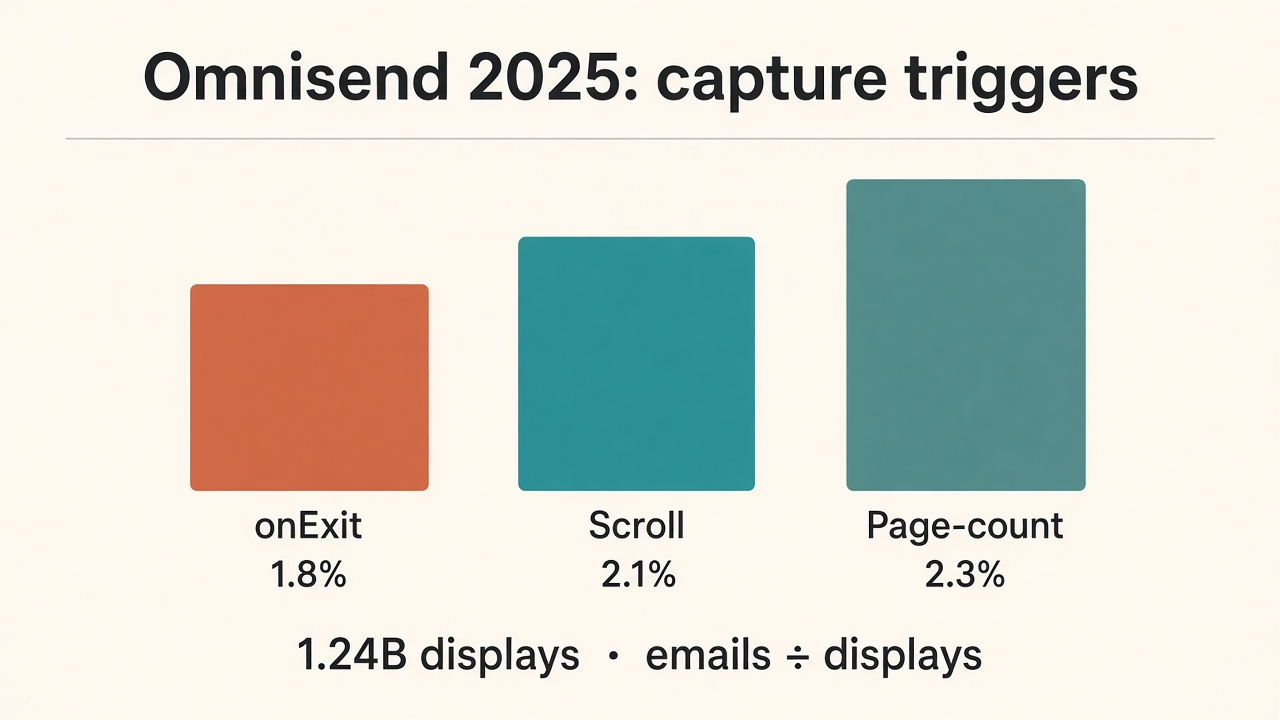
Source: Omnisend, Email popup performance in 2025. https://www.omnisend.com/blog/email-popup-statistics/.
Popupsmart’s page split is the operator rule hiding under trigger religion: cart and checkout 4.57% versus home 1.07%. OptiMonk’s 17.12% is the same intuition with a vendor use-case cut. Cart abandonment still starts with extra costs (40% of non-browse reasons) and guest checkout — not a modal. If the leak is a surprise shipping line, an exit overlay offering 10% is a bribe sitting on a broken total.
List-growth overlays belong on the email-list-growth spoke. Salvage overlays belong on cart. Mixing them inflates the homepage KPI and starves the cart KPI.
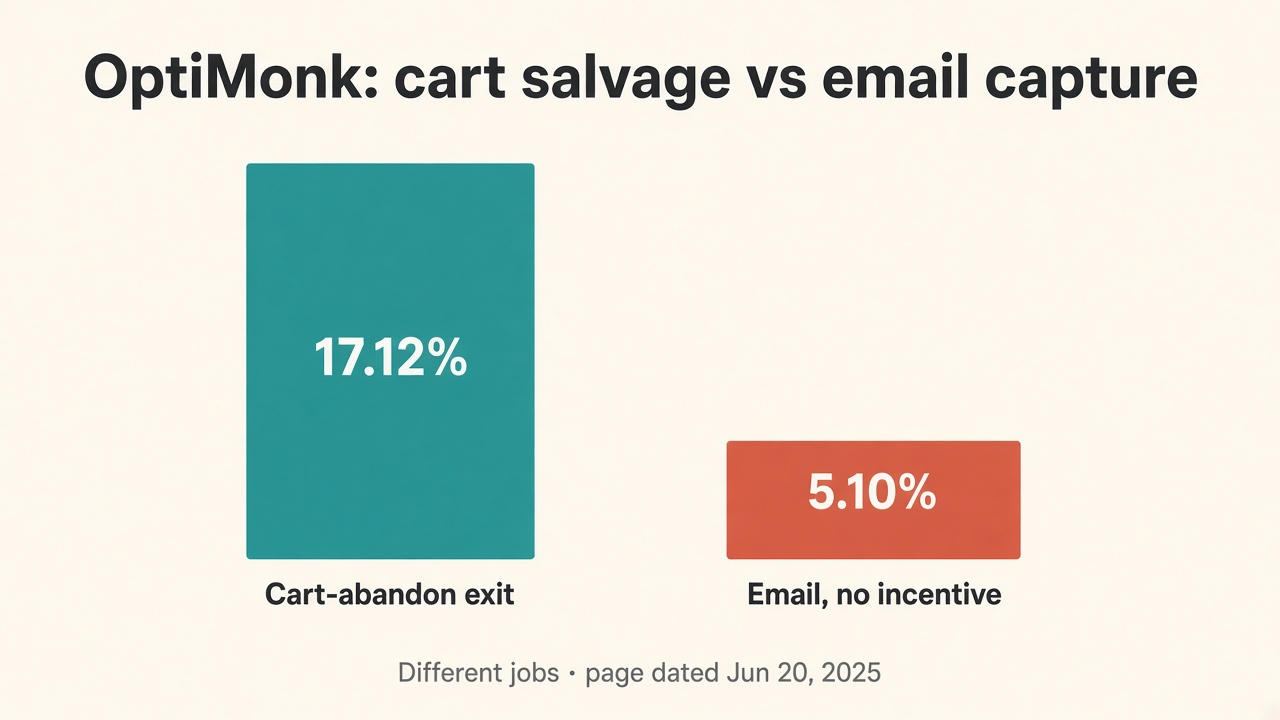
Source: OptiMonk popup statistics, dated June 20, 2025. https://www.optimonk.com/popup-statistics. Different conversion definition than Omnisend emails ÷ displays.
Desktop exit intent is a real event: cursor velocity toward chrome. Phones do not expose that. Vendors infer from rapid upward scroll, back-button intercepts, or idle. Shopify merchants keep rediscovering it: Privy-style desktop exit “doesn’t work on mobile,” and community CRO advice is to measure with a randomized holdout among sessions that meet the same inferred rule (Shopify Community). Frequency caps matter more on a screen the overlay covers.
Omnisend’s device cells (2.2% mobile or both vs 1.4% desktop-only) are where the form can show, not a mobile-exit conversion census. Do not quote them as proof that “mobile exit intent converts higher.”
Reddit anecdotes (3.5–4% on a 15-minute 15% off; 4.5% on first-purchase 10%) sit in the Omnisend “good” band for capture if they count submits per display (r/ecommerce). They are not OptiMonk’s cart cell. They are not a pooled Shopify law.
Run this sequence before you buy another overlay app. Each step is at most two sentences.
Q: What is a good exit intent popup conversion rate in 2026? A: For email capture, plan from Omnisend’s 2025 onExit ~1.8% (below scroll ~2.1%) or Wisepops’ 3.94% exit cell — labeled, not averaged. Cart-abandonment exit on OptiMonk is 17.12% and is a different job. Popupsmart’s median exit gap is not statistically reliable.
Q: Do exit intent popups convert better than scroll popups? A: Not for list growth on the two largest labeled signup panels. Omnisend puts scroll near 2.1% and onExit near 1.8%. Wisepops puts scroll at 5.37% and exit at 3.94%. Use exit as last-chance salvage, not as your primary capture trigger.
Q: Are cart abandonment popups the same as exit intent? A: No. Exit intent is a trigger. Cart abandonment is a page and an intent state. OptiMonk’s 17.12% cell is exit-intent shown to people who already have items in cart. Homepage exit overlays do not inherit that rate.
Q: Do exit intent popups work on mobile? A: Classic cursor-leave does not fire on phones. Tools infer from upward scroll, back gestures, or idle time, which creates false positives. Test the inferred rule with a holdout and cap frequency; do not quote desktop onExit as a mobile rate.
Q: Can I quote 10–17% as the industry exit-intent conversion rate? A: No. That band appears when listicles blend Wisepops-style capture rates with OptiMonk’s cart-abandon cell. There is no public dataset for a universal Shopify exit-intent take rate. Quote the labeled rung that matches your job.
Exit intent popup conversion benchmarks reward merchants who name the job. Omnisend’s 2025 census puts capture onExit near 1.8%, colder than scroll, while OptiMonk’s 17.12% is cart salvage on a different panel. Popupsmart says the trigger lift itself may be chance; the page you fire on is not. Keep desktop cursor-leave and mobile inference on separate meters, and leave list-growth form types on their own spoke.
If you want distribution that already converts attention into affiliate-sold storefronts, list on feat..
Product quiz conversion rate benchmarks are a Quiz Denominator Ladder: RevenueHunt 5.5% of completers; ConvertFlow 5.2% of viewers. Not sitewide CVR.
Size guide conversion rate impact is a Size Confidence Ladder: Baymard 83%/87% fail sufficiency; Snipes Fit Finder +3% all-traffic vs a static chart.
Sticky add to cart conversion lift: Vitals 9.3% of orders involve the bar; Growth Rock +7.9% desktop vs scroll-to-section with no order lift.