Affiliate Marketing for Startups: Complete Guide
Affiliate marketing for startups is an operating system—locks, cost, recruit, rates, tracking, first 100 sales, then diagnose a flat roster.
Affiliate marketing vs reselling: resellers buy stock and keep about 50% at keystone. Affiliates never take title and earn 5%-15% on physical goods.

TL;DR: Affiliate marketing vs reselling turns on one question: do you take title to the goods? A reseller buys stock at wholesale, often prices at keystone (double the cost, about 50% gross margin), and owns sales tax and returns. An affiliate never owns the product and earns about 5%–15% on physical goods. “Reseller without inventory” means dropshipping or affiliate.
People searching affiliate marketing vs reselling usually want the same thing: sell products they didn’t make, without much money up front. The two models answer that very differently. One makes you a shop. The other makes you a recommender who gets paid.
The confusion is “reseller without inventory.” A reseller, in the ordinary sense, buys goods and sells them again. Take away the inventory and you are not reselling anymore. You are either dropshipping, where you’re still the seller of record, or you’re an affiliate, where you never are. Naming which one you want saves a lot of wasted supplier emails.
Key takeaways:
Reselling is buying products, taking ownership of them, and selling them to your own customers at your own price; affiliate marketing is promoting someone else’s product and earning a commission when a buyer purchases on their checkout.
The legal word that separates them is title. When you resell, title passes to you when you buy the goods. You can set any price, you carry the stock, and when a buyer wants a refund, they ask you. When you’re an affiliate, title never passes to you. The merchant owns the product until the buyer does, and your job ends at the referral.
Dropshipping sits in between. You never hold the box, but you are the seller the buyer pays. That is why dropshipping vs affiliate marketing is a risk question, and this page is an ownership question. If you want every way to sell a product you don’t make in one place, how to sell someone else’s product online lays out all four.
Whoever takes title takes the stock, the cash, the tax paperwork, and the returns. In exchange, they set the price and keep the margin. Reselling at keystone keeps about half the retail price before overhead. Affiliate marketing keeps 5%–15% on physical goods but risks nothing on inventory. The title question settles which trade you’re making.
What changes with title:
The Title Test is three questions in order. Do you buy the goods first? Then you’re a reseller. If not, are you the seller of record the buyer pays? Then you’re a dropshipper. If not, do you want your own page? Then you want a co-branded storefront. Otherwise, an affiliate link.
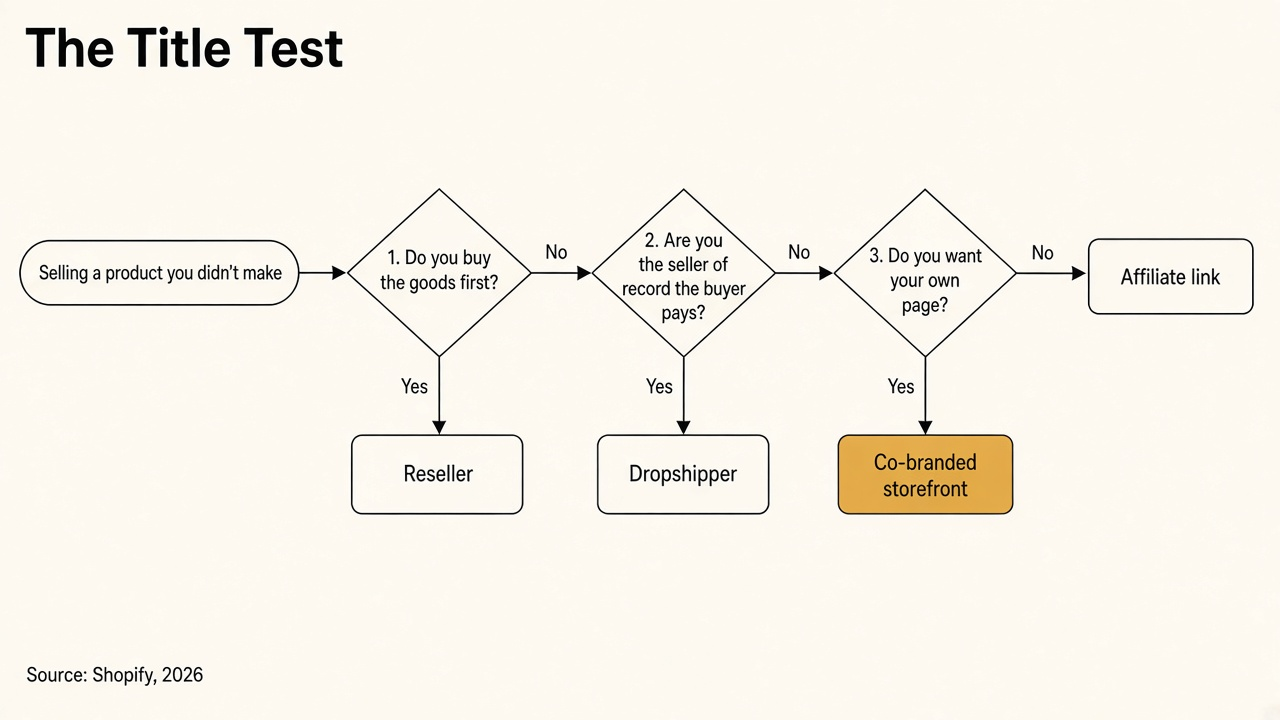
Source: Editorial decision flow based on Shopify, 2026. https://www.shopify.com/blog/resale-certificate · https://www.shopify.com/blog/what-is-keystone-pricing
| Reseller | Dropshipper | Co-branded storefront | Affiliate link | |
|---|---|---|---|---|
| Takes title to goods | Yes | Briefly, as seller of record | No | No |
| Cash before first sale | Wholesale stock | Supplier payment per order, ads | None | None |
| Sets the price | Yes | Yes | Merchant | Merchant |
| Typical cut | ~50% gross at keystone | 20%–50% margin | Revenue split per listing | 5%–15% physical; 20%–50% digital |
| Seller’s permit and resale certificate | Usually | Usually | No | No |
| Handles returns | Yes | Yes | Merchant | Merchant |
The cut figures are Shopify’s published bands. Keystone is a pricing convention, not a guarantee. The 20%–50% dropship band is from Shopify’s dropshipping guide.
Shopify’s own keystone example is a $14 ceramic mug priced at $28. Here is that mug through both models. Every number is arithmetic on Shopify’s figures.
| One $28 mug | Reseller at keystone | Affiliate, physical band |
|---|---|---|
| Gross cut per sale | $14 (about 50%) | $1.40–$4.20 (5%–15%) |
| Cash out before 100 sales | $1,400 for 100 units | $0 |
| Unsold stock risk | Yours | Merchant’s |
| Shipping, duties, overhead | Comes out of the $14 | Merchant’s |
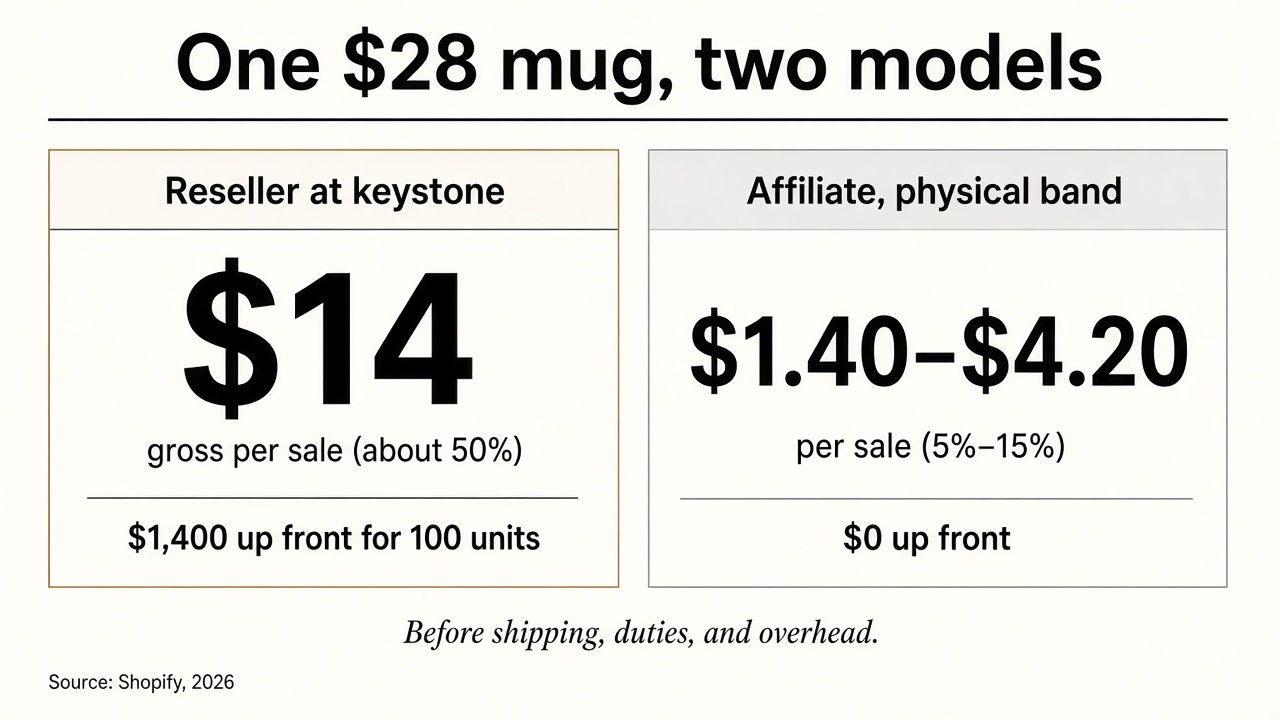
Source: Arithmetic on Shopify, 2026. https://www.shopify.com/blog/what-is-keystone-pricing · https://www.shopify.com/blog/affiliate-commission
The reseller’s $14 is real money, about three to ten times the affiliate’s cut. It is also money you have already spent once. If 30 of the 100 mugs never sell, the reseller’s margin on the other 70 has to pay for them. There is no public dataset for average sell-through on a first reseller order, so plan for some dead stock.
Not in the strict sense. The r/smallbusiness answer to “can I start an ecommerce business without products?” was blunt: “You’re basically describing drop-shipping” (r/smallbusiness). The same thread suggested pre-orders as a way to “test the market without needing to invest in inventory upfront.”
So “reseller without inventory” splits into three real options:
A co-branded storefront is the affiliate side with a shop’s face. On feat., a merchant lists a product and sets the revenue split. An approved seller gets their own page to share. Checkout, fulfillment, and refunds stay with the merchant. You don’t take title and you don’t need a resale certificate. feat. doesn’t publish a fee sheet on this page, and I won’t invent one. The live split shows in the product.
The tradeoff is honest. You don’t set the price, and your cut is the listing’s split, not a keystone 50%. If price control is the whole point, resell. If the point is having something you can call your shop without buying stock, that’s the storefront. How to turn anyone into a seller covers the merchant side of that bargain.
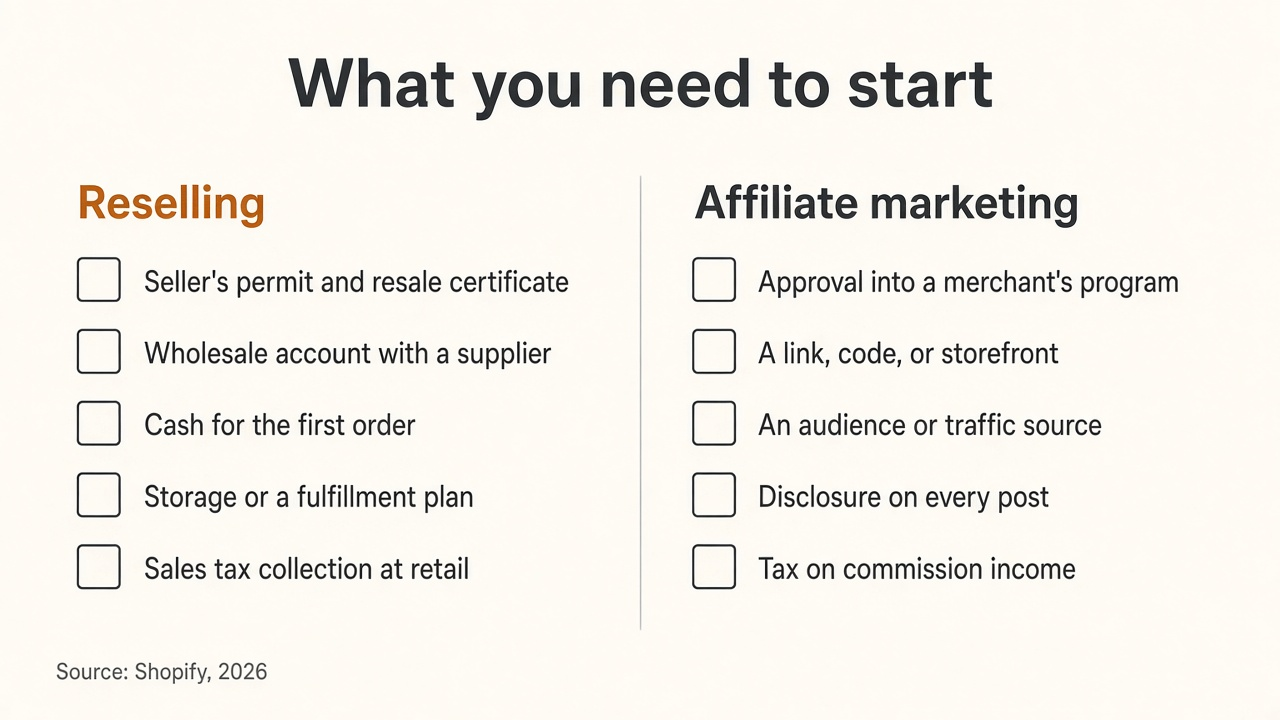
Source: Editorial checklist based on Shopify, 2026. https://www.shopify.com/blog/resale-certificate · https://www.shopify.com/blog/affiliate-marketing
| To start reselling | To start affiliate marketing |
|---|---|
| Seller’s permit and resale certificate | Approval into a merchant’s program |
| Wholesale account with a supplier | A link, code, or storefront |
| Cash for the first order | An audience or traffic source |
| Storage or a fulfillment plan | Disclosure on every post |
| Sales tax collection at retail | Tax on commission income |
Disclosure is the one affiliate requirement people skip. Affiliate marketing disclosure rules has the FTC wording.
These six steps pick the model. Each step is at most two sentences.
Q: What is the difference between affiliate marketing and reselling? A: A reseller buys products, takes ownership, and sells them at their own price. An affiliate never owns the product and earns a commission when a buyer purchases on the merchant’s checkout. Resellers keep more per sale but carry stock, tax, and returns.
Q: Can I be a reseller without inventory? A: Not in the strict sense, because reselling means buying the goods first. Without inventory you’re either dropshipping, where you’re still the seller of record, or an affiliate, where you never are. Pre-orders are the one way to resell without buying ahead, and you still owe delivery.
Q: Is reselling more profitable than affiliate marketing? A: Per sale, usually yes: keystone pricing keeps about 50% gross, against 5%–15% for a physical affiliate sale. Per dollar at risk, affiliate marketing often wins, because there is no stock to front and no dead inventory. There is no public dataset comparing net income across the two models.
Q: Do I need a resale certificate to be an affiliate? A: No. A resale certificate is for buying goods tax-free that you will resell, and affiliates never buy the goods. Resellers usually need a seller’s permit and a resale certificate, and affiliates still owe tax on commission income.
Q: Is a reseller program the same as an affiliate program? A: No. A reseller program sells you product or service at a discount so you can resell it under your terms. An affiliate program pays you for referring buyers to the merchant’s checkout. Some companies run both, and the contracts differ on who owns the customer.
Affiliate marketing vs reselling is a Title Test. Resellers take title, front the cash, price at something like keystone, and own tax and returns. Affiliates never take title and earn 5%–15% on physical goods with nothing up front. If you want a shop’s face without the stock, a co-branded storefront is the middle path. Find a product to sell without buying inventory on the feat. marketplace.
Affiliate marketing for startups is an operating system—locks, cost, recruit, rates, tracking, first 100 sales, then diagnose a flat roster.
How to track affiliate sales: pick link cookie, coupon, pixel, S2S postback, or storefront checkout—then match Rewardful, Tapfiliate, or Impact.
Best affiliate programs for SaaS companies pass the Recurring Cap Test: labeled duration, cookie, seat type, payout rails—plus Rewardful’s ~24% planning band.