Affiliate Marketing for Startups: Complete Guide
Affiliate marketing for startups is an operating system—locks, cost, recruit, rates, tracking, first 100 sales, then diagnose a flat roster.
Dropshipping vs affiliate marketing: Shopify puts dropship margins at 20%-50% and physical affiliate cuts at 5%-15%. The real gap is who holds the risk.

TL;DR: Dropshipping vs affiliate marketing is a choice about who holds the risk, not just who earns more per sale. Shopify puts dropshipping margins at 20%–50%, but the dropshipper also owns ads, refunds, support, and sales tax. Affiliates earn about 5%–15% on physical goods and carry almost none of that. Pick the model whose losses you can absorb.
Every “dropshipping vs affiliate marketing” thread argues about margin. The dropshipper keeps more of each sale, the affiliate keeps less, and the thread ends there. That leaves out the part that decides whether you make money: who pays when the ad doesn’t convert, the package arrives broken, or the buyer charges back.
I have sat on both sides of that ledger. As a merchant, I want sellers who never touch my inventory. As a seller, I want the biggest cut I can get without owning a support inbox. The honest comparison is a risk table, not a margin table.
Key takeaways:
Dropshipping is selling a product on your own store at your own price while a supplier ships it to the buyer; affiliate marketing is sending a buyer to someone else’s checkout and earning a commission on the sale.
The legal difference is the one that matters. A dropshipper is the merchant of record. The buyer pays you, so the refund, the chargeback, the late package, and the sales tax are yours. An affiliate is never the seller. The buyer pays the merchant, and you get paid if the attribution sticks.
The r/ecommerce version is blunter: “Dropshipping is a fulfillment model, not a business plan” (r/ecommerce). Another reply in the same thread: affiliate marketing lets you “focus on the most important part and let others deal with the customers.” Both are true. Fulfillment is the job you are signing up for or declining.
If you are still choosing among every way to sell a product you don’t make, how to sell someone else’s product online lays out all four. This page is the head-to-head between two of them.
Margin is what you keep when everything goes right. Risk is what you pay when it doesn’t. Dropshipping pays a bigger cut because the dropshipper absorbs ad losses, refunds, and support. Affiliate marketing pays a smaller cut because the merchant absorbs them. Compare models on the bad month, not the good one.
Why the bad month decides it:
The Risk Transfer Line asks one question per risk: who pays when it goes wrong? Dropshipping puts ads, inventory payment, support, returns, and tax on the seller in exchange for a 20%–50% margin. Affiliate marketing puts them on the merchant in exchange for a 5%–15% physical cut. A co-branded storefront splits them.
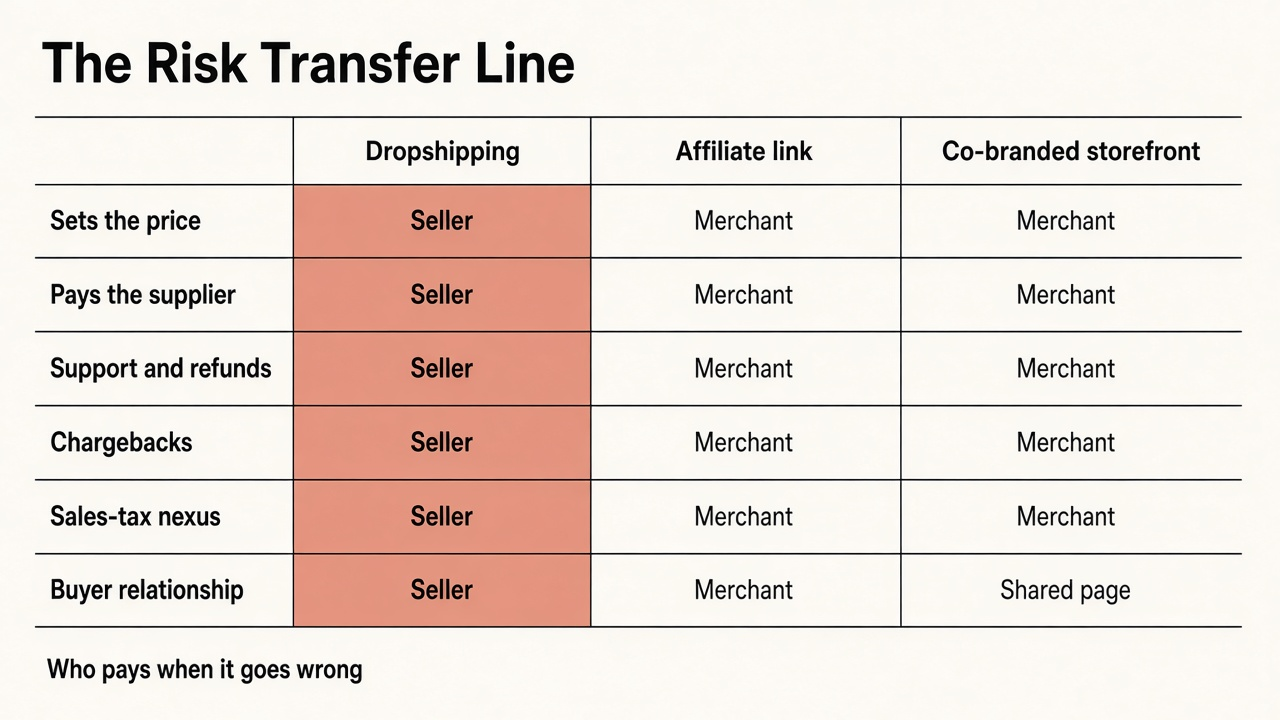
Source: Editorial matrix based on Shopify, 2026. https://www.shopify.com/blog/is-dropshipping-worth-it · https://www.shopify.com/blog/affiliate-marketing
| Risk | Dropshipping | Affiliate link | Co-branded storefront |
|---|---|---|---|
| Sets the price | Seller | Merchant | Merchant |
| Pays the supplier or holds stock | Seller | Merchant | Merchant |
| Customer service and refunds | Seller | Merchant | Merchant |
| Chargebacks | Seller | Merchant | Merchant |
| Sales-tax nexus as merchant of record | Seller | Merchant | Merchant |
| Owns the buyer relationship | Seller | Merchant | Shared page, merchant checkout |
| Commission or margin set by | Market minus supplier | Merchant’s program | Revenue split per sale |
| Typical cut (Shopify bands) | 20%–50% margin | 5%–15% physical; 20%–50% digital | Set by the listing |
Per sale, dropshipping. Per dollar at risk, usually affiliate marketing. The table below is arithmetic on Shopify’s published bands for a single $100 order. It is not an income forecast.
| Per $100 order | Dropshipping | Affiliate, physical | Affiliate, digital |
|---|---|---|---|
| Gross cut before ads (Shopify band) | $20–$50 | $5–$15 | $20–$50 |
| Inventory or supplier cash at risk | Yes | No | No |
| Refund and support cost | Seller | Merchant | Merchant |
| Health and beauty CAC benchmark | $127 | $127 if you buy traffic | $127 if you buy traffic |
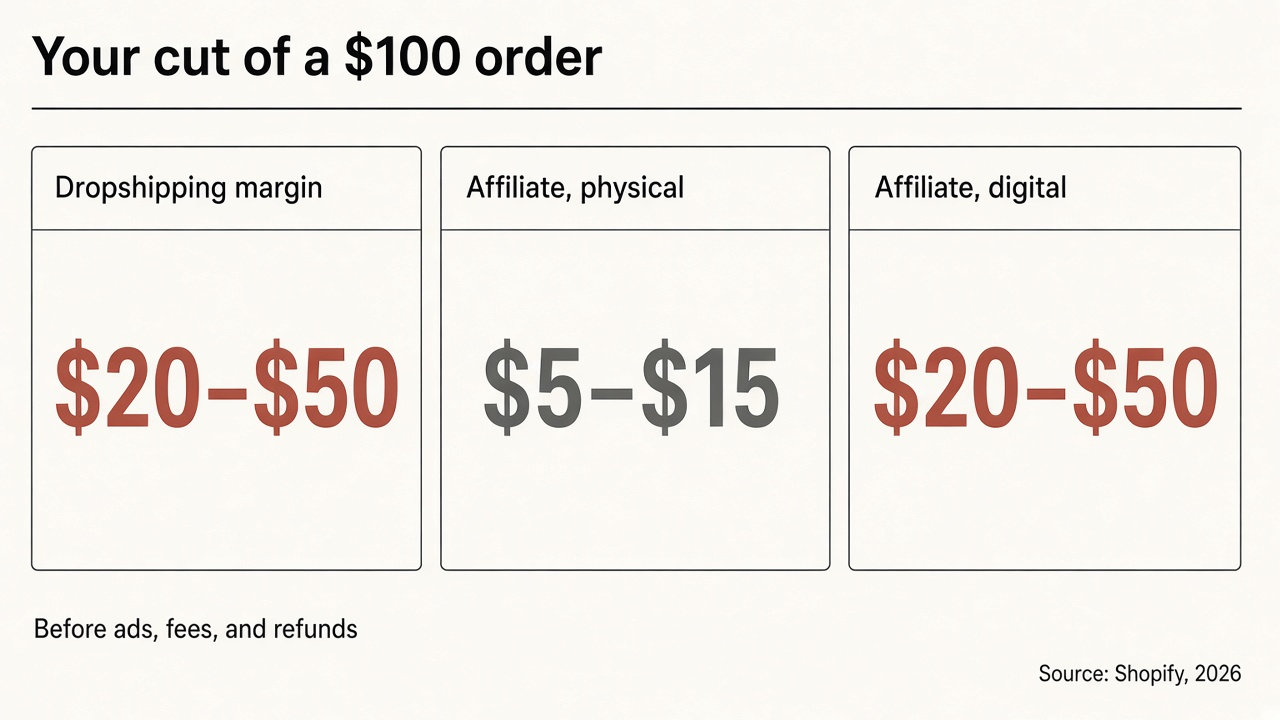
Source: Shopify, 2026. https://www.shopify.com/blog/is-dropshipping-worth-it · https://www.shopify.com/blog/affiliate-commission
The digital column is the one most comparisons skip. A digital affiliate offer can pay the same band as a dropship margin with none of the fulfillment. Digital product affiliate marketing vs physical goods runs that margin stack.
Both models hit the same wall when traffic is paid. Shopify’s benchmarks are per acquired customer, not per order, so repeat purchase changes the math. Even so, the spread shows why so many stores go negative in the first quarter.
| Category | Ecommerce CAC benchmark | Dropship margin on a $100 order |
|---|---|---|
| Arts and entertainment | $21 | $20–$50 |
| Health and beauty | $127 | $20–$50 |
| Fashion and accessories | $129 | $20–$50 |
| Electronics | $377 | $20–$50 |
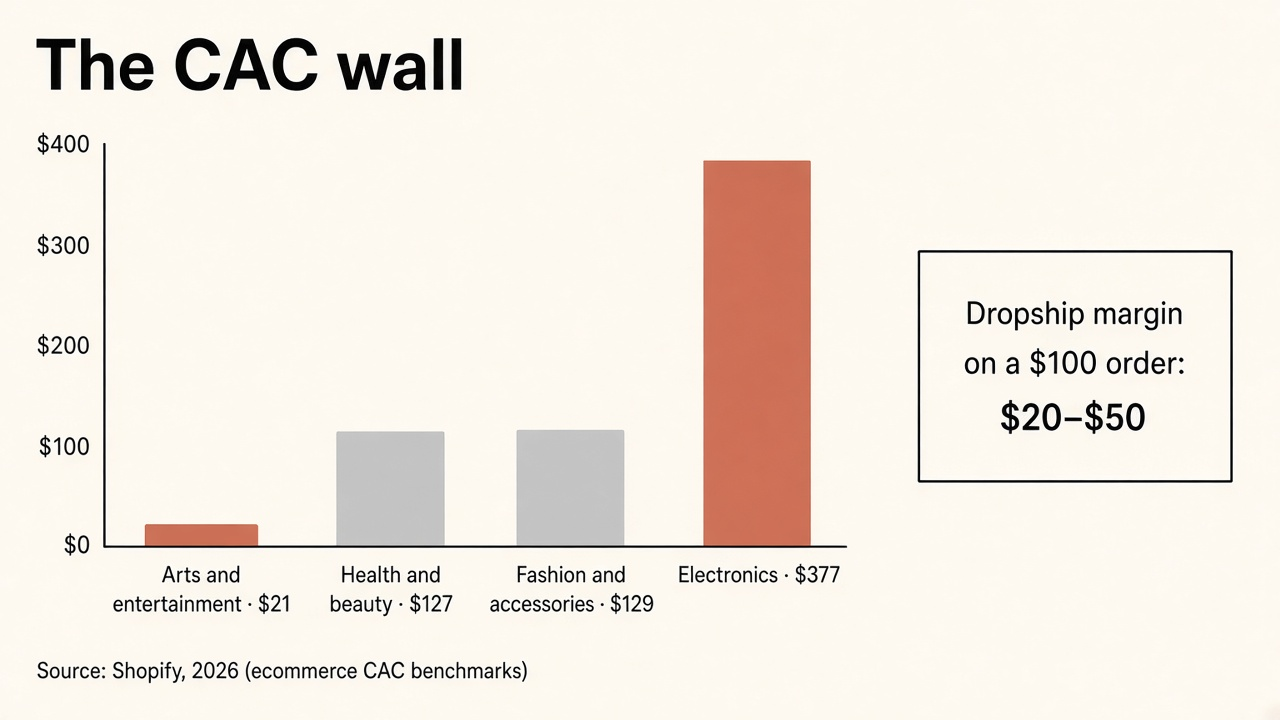
Source: Shopify, 2026. https://www.shopify.com/blog/is-dropshipping-worth-it
If you own an audience, the wall mostly disappears for affiliates, because your traffic is already paid for in content. If you don’t, how to start affiliate marketing with no audience is the slower and cheaper path.
Affiliate marketing, for most people with little capital. The r/ecommerce thread lands there, and Shopify’s own guides agree on the reason. You can be wrong about a product without having paid a supplier. The exception is someone with ad-buying skill and enough cash to survive testing. That person can learn faster with dropshipping, because paid traffic gives feedback in days.
Most people who end up running a product business did not start with inventory. They sold someone else’s product first, learned which offers their audience bought, and only then took on fulfillment. The r/ecommerce advice is the same order: learn marketing first, “then you can consider whether or not you want to start selling ‘your own’ product via drop shipping.”
That order is cheap insurance. Affiliate sales tell you what converts before you prepay a supplier. If a product sells well through your links for three months, you have demand data a dropshipper would have paid ads to get. If it doesn’t, you lost time, not stock. There is no public dataset on how many dropshippers started as affiliates, so treat this as an operator pattern, not a statistic.
A storefront is for the seller who wants their own page without becoming the merchant of record. On feat., a merchant lists a product and an approved seller gets a co-branded storefront. The merchant keeps checkout, fulfillment, and refunds. The revenue split is set on the listing. feat. does not publish a fee sheet here, and I won’t invent one. The live split shows in the product. If you want a dropshipper’s brand control without a dropshipper’s support inbox, that is the slot.
These six steps pick the model. Each step is at most two sentences.
Q: Is dropshipping or affiliate marketing better? A: Affiliate marketing is better for most people with little capital, because the merchant holds inventory, support, and refunds. Dropshipping is better for someone who can buy traffic profitably and wants to set price. Shopify puts dropship margins at 20%–50% and physical affiliate commissions at 5%–15%.
Q: Is affiliate marketing better than dropshipping for beginners? A: Usually, yes. A beginner can be wrong about a product without having paid a supplier or answered a refund. Dropshipping gives faster feedback through paid ads, but it needs cash to survive testing.
Q: Which is more profitable, dropshipping or affiliate marketing? A: Dropshipping keeps more per sale, often $20–$50 on a $100 order under Shopify’s band, against $5–$15 for a physical affiliate sale. Affiliate marketing usually keeps more per dollar at risk, especially on organic traffic or 20%–50% digital offers. Neither number is an income forecast.
Q: How much does it cost to start dropshipping vs affiliate marketing? A: Dropshipping needs a store, samples, and ad tests, and Shopify’s CAC benchmarks run $21 to $377 per customer by category. Affiliate marketing can start with a content account and no product cost. There is no public dataset for the median startup budget of either model.
Q: Do affiliates need inventory like dropshippers? A: No. Dropshippers don’t hold inventory either, but they pay the supplier and become the seller of record. Affiliates never take the sale, so stock, shipping, and refunds stay with the merchant.
Dropshipping vs affiliate marketing comes down to the Risk Transfer Line. Dropshipping pays a 20%–50% margin because you carry ads, refunds, support, and tax. Affiliate marketing pays 5%–15% on physical goods, or 20%–50% on digital, because the merchant carries them. Pick the losses you can survive. If you want your own page without becoming the seller of record, find a product to sell on the feat. marketplace.
Affiliate marketing for startups is an operating system—locks, cost, recruit, rates, tracking, first 100 sales, then diagnose a flat roster.
How to track affiliate sales: pick link cookie, coupon, pixel, S2S postback, or storefront checkout—then match Rewardful, Tapfiliate, or Impact.
Best affiliate programs for SaaS companies pass the Recurring Cap Test: labeled duration, cookie, seat type, payout rails—plus Rewardful’s ~24% planning band.