Average Cost per Content Piece by Format (2026 Ranges)
Average cost per content piece by format: WebFX ranges, freelancer modal rates, and why one national average is a myth.
How long content takes to rank by domain authority, with Ahrefs base rates, page-age data, and why DA score calendars are mostly fiction.

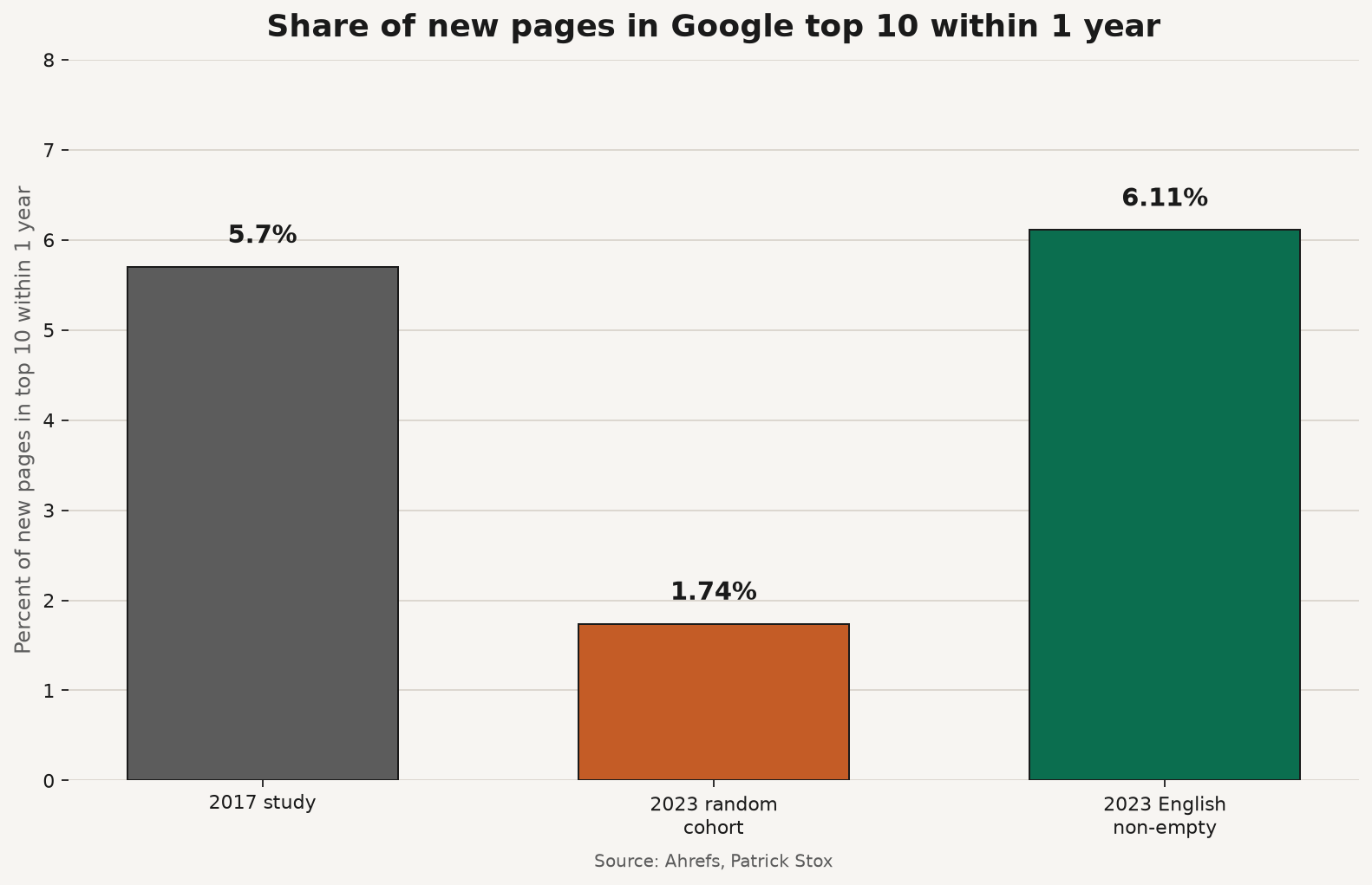
TL;DR: How long content takes to rank by domain authority is mostly a probability problem. Ahrefs found only 1.74% of new pages hit Google’s top 10 within a year (6.11% for non-empty English). Of pages that do, 40.82% rank in month one. Domain trust can speed low-comp wins. It does not create a DA-score calendar.
Founders keep asking for a month number. Agencies keep answering “three to six months.” Both sides skip the harder truth: most new URLs never crack the top 10 in year one, and the ones that do often move early or stall.
If you are planning budgets around how long content takes to rank by domain authority, start with base rates, then treat authority as a speed and odds multiplier, not a spreadsheet of Moz scores mapped to weeks. Build the pages that can compound inside a topic cluster, measure them with honest content marketing ROI benchmarks, and do not confuse indexation with revenue.
Ranking speed by domain authority is how quickly a new or updated URL can earn stable visibility in Google for a target query, given the site’s accumulated trust, topical coverage, links, and competition, not a single third-party score.
People say “domain authority” when they mean site trust. Moz Domain Authority and Ahrefs Domain Rating are useful relative scores. Google does not publish either metric as a ranking factor. Forums still treat them as speed knobs, which is why the search phrase mixes a real job with a fake dial.
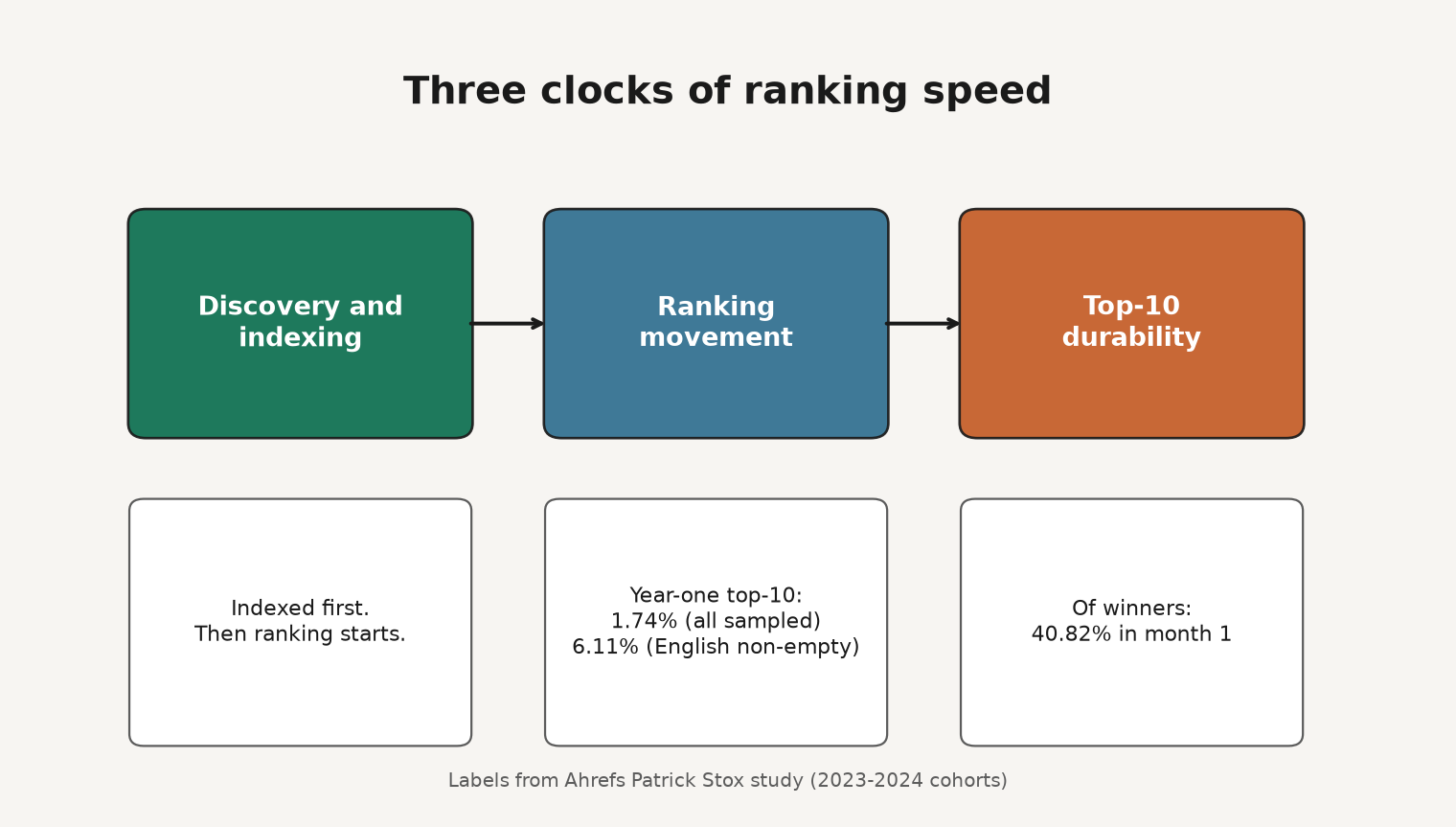
The clean split is three clocks:
Most “how long until we rank” fights confuse those clocks. A page can be indexed in a day and still sit on page four for a year. A trusted site can place a long-tail page in a week and still never win a head term. Authority helps the second clock on easy queries. It does not guarantee the third.
Timelines matter because content spend is a capital allocation problem with a long payback window. Mis-set expectations and you either kill winners too early or fund losers forever.
Source: Ahrefs, Patrick Stox study of 2023 to 2024 cohorts. https://ahrefs.com/blog/how-long-does-it-take-to-rank-in-google-and-how-old-are-top-ranking-pages/.
If your board wants a single number, give them a range with a kill rule. If they want a DA score promise, refuse it. That refusal is more citable than a fake table.
New pages rarely waltz into the top 10. Ahrefs’ cohorts show most URLs never get there in year one. Pages that do often move in the first month, high-volume terms stay rare, and after about six months without a foothold you should update the asset. Domain trust can compress the timeline on low-competition queries. It does not rewrite those base rates.
Higher site trust usually helps Google crawl you more often and take low-competition pages seriously sooner. That matches what operators report on established domains. It does not mean a DA 40 site has a published “eight-week” clock and a DA 20 site has a “twenty-week” clock.
Use authority as a qualitative band:
| Site trust band (qualitative) | What operators usually see | What the public data supports |
|---|---|---|
| New domain, thin topical coverage | Slow crawl, weak first impressions, months before meaningful traffic | Matches community language; no official sandbox duration from Google |
| Mid-trust site with a few strong clusters | Low-comp pages can move in weeks; head terms still slow | Consistent with Ahrefs: low-volume terms distribute more evenly over time |
| High-trust site in a focused niche | Fast indexing; some pages can hit page one quickly on easy queries | Matches the 40.82% of eventual top-10 pages that landed in month one |
| Any band chasing high-volume head terms | Long odds; many pages never rank for those terms at all | Ahrefs notes 94% of pages never ranked for high-volume keywords in the high-volume slice they studied |
Source: Ahrefs, Patrick Stox. https://ahrefs.com/blog/how-long-does-it-take-to-rank-in-google-and-how-old-are-top-ranking-pages/.
Ahrefs found it takes longer to rank for high-volume keywords than for low-volume ones. When a page was going to rank for a higher-volume term, it was more likely to do so in the first month. Lower-volume terms were more evenly distributed across the year. Translation for founders: pick winnable queries first, then expand. Do not staff a content team on head terms and expect month-three miracles.
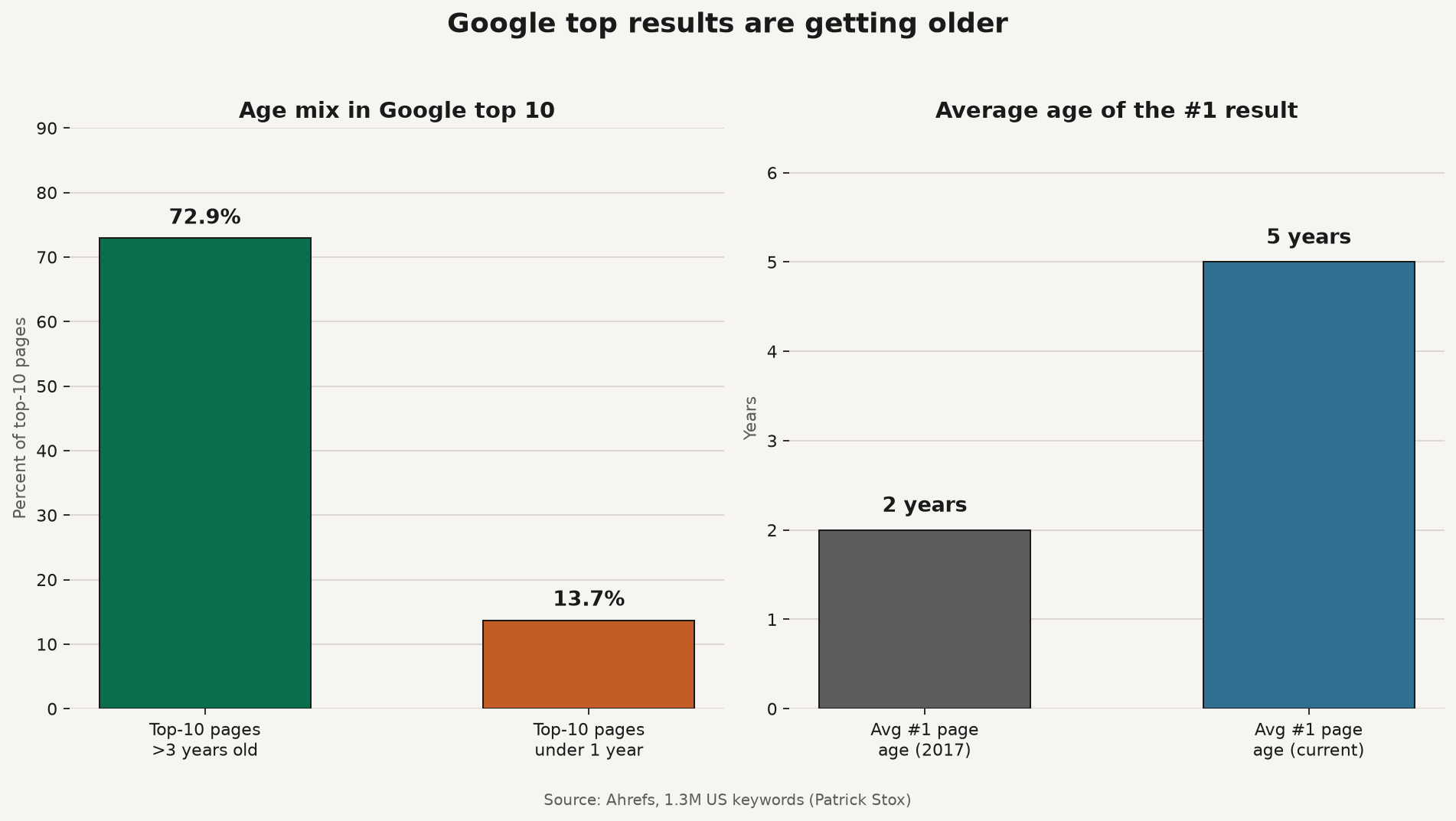
Page age is not a Google “ranking factor” you can hack with a fake publish date. It is a proxy for accumulated links, refreshes, brand mentions, and user satisfaction. Ahrefs’ 1.3 million keyword sample shows the SERP getting older: more than seven in ten top-10 URLs are past the three-year mark, and the typical #1 result is five years old. That is an argument for evergreen-capable formats you will maintain, not for one-and-done posts.
Backlinko and BuzzSumo’s analysis of 3.6 billion articles found list posts were 15x more likely to become evergreen than presentations, using BuzzSumo’s Evergreen Score (engagement and links after day 30) (Backlinko; BuzzSumo definition). Format will not override a weak site. It does raise the odds that the page is worth updating six months later.
Source: Ahrefs, Patrick Stox (1.3M US keywords). https://ahrefs.com/blog/how-long-does-it-take-to-rank-in-google-and-how-old-are-top-ranking-pages/.
Organic ranking is a long asset. Paid and affiliate distribution can sell while you wait. That is the same brand-versus-activation tradeoff covered in content marketing vs performance marketing. Use SEO for compounding answers. Use partners and paid for demand you need this quarter. Repurpose the pillar so it works on more surfaces while Google decides (content repurposing frameworks).
Use this sequence when a stakeholder asks how long content takes to rank by domain authority. Each step is two sentences or fewer.
Q: How long does content take to rank by domain authority? A: There is no public DA-score calendar. Ahrefs found only 1.74% of new pages (6.11% for non-empty English) reached Google’s top 10 within a year, and 40.82% of those winners did so in the first month. Treat domain trust as a speed factor on easier queries, not a months lookup table.
Q: How long does SEO take for a new website? A: New domains usually need months before traffic is meaningful because crawl trust and topical coverage are thin. Low-competition pages can still earn early impressions once indexed. Competitive head terms often take longer than a year, if they rank at all.
Q: Why do some new pages rank in days while others take a year? A: Indexing speed, query competition, on-page intent match, internal links, and existing site trust all move the clock. Ahrefs also shows that among pages that eventually reach the top 10, a large share do so within one month, so early movement is common for winners and rare for everyone else.
Q: Does a higher Moz Domain Authority guarantee faster rankings? A: No. Moz DA and similar scores are relative third-party metrics. They can correlate with stronger sites, but there is no public dataset that converts a DA number into a guaranteed ranking month.
Q: When should I update a page that is not ranking? A: Use Ahrefs’ roughly six-month checkpoint: if you are still outside the top 10, update the content, tighten intent match, and improve links rather than waiting for a spontaneous jump. Keep pages that match durable jobs so updates compound instead of starting over.
How long content takes to rank by domain authority is the wrong question if you expect a score-to-calendar chart. The better question is which pages have a real shot at the top 10, how early winners tend to announce themselves, and how you will sell while organic authority compounds. Ahrefs’ base rates, page-age data, and the missing DA ladder are enough to plan without fiction.
If you already built the product, list it on feat. so affiliates can sell it through co-branded storefronts while your pages earn their rankings.
Average cost per content piece by format: WebFX ranges, freelancer modal rates, and why one national average is a myth.
Evergreen vs trending content compared with OkDork share-decay data, evergreen format odds, and a job-first mix (not a fake 70/30).
Content repurposing frameworks: CMI challenge rates, a job-first pillar-to-derivative map, and why rewrite-not-reformat beats paste-and-pray.