Evergreen vs Trending Content: How to Choose
Evergreen vs trending content compared with OkDork share-decay data, evergreen format odds, and a job-first mix (not a fake 70/30).
Average cost per content piece by format: WebFX ranges, freelancer modal rates, and why one national average is a myth.

TL;DR: Average cost per content piece by format is a set of ranges, not one national mean. WebFX’s survey of 350+ marketers puts blogs near $150-$600, long-form guides $500-$2,500, ebooks/whitepapers $1,500-$10,000+, and video $1,000-$15,000, while Peak Freelance’s 213 writers most often ask $250-$399 for a 1,500-word post. Budget the format and the all-in stack, not a fake average.
Founders ask for the average cost per content piece by format so they can fill a spreadsheet. Spreadsheets punish honesty. A $150 blog and a $2,500 technical guide are both “posts” only in the same way a bicycle and a truck are both vehicles.
Average cost per content piece by format should mean published survey ranges by deliverable type, plus a clear line between writing-only invoices and all-in production. Pair this with content marketing ROI benchmarks, how long content takes to rank, evergreen vs trending, and topic cluster build costs in time.
Average cost per content piece by format means estimated production spend for a finished deliverable type (blog, long-form guide, whitepaper, video, social pack), usually published as a range from surveys or rate cards, not as a single marketwide mean. If a deck collapses those ranges into one cell, it is already lying about quality tier.
That definition already kills the LinkedIn graphic that claims “the average blog post costs $X.” WebFX asks marketers what companies spend and what formats cost; Peak Freelance asks writers what they charge; Orbit asks how long a piece takes. Those are related objects. They are not the same number. A freelancer’s $300 invoice is not your fully loaded cost if a strategist briefed it, an editor rewrote it, a designer built the chart, and someone else spent a day on distribution.
Treat every quote as answering one of three questions: writing-only, managed deliverable, or all-in program cost. If the vendor cannot say which, assume you are buying ambiguity.
They matter because format mix, not headcount slogans, decides whether a $6,000 month buys six thin posts or two assets that can actually rank and convert. A spreadsheet that uses one average cost per piece will overfund filler and underfund the pieces that carry the strategy.
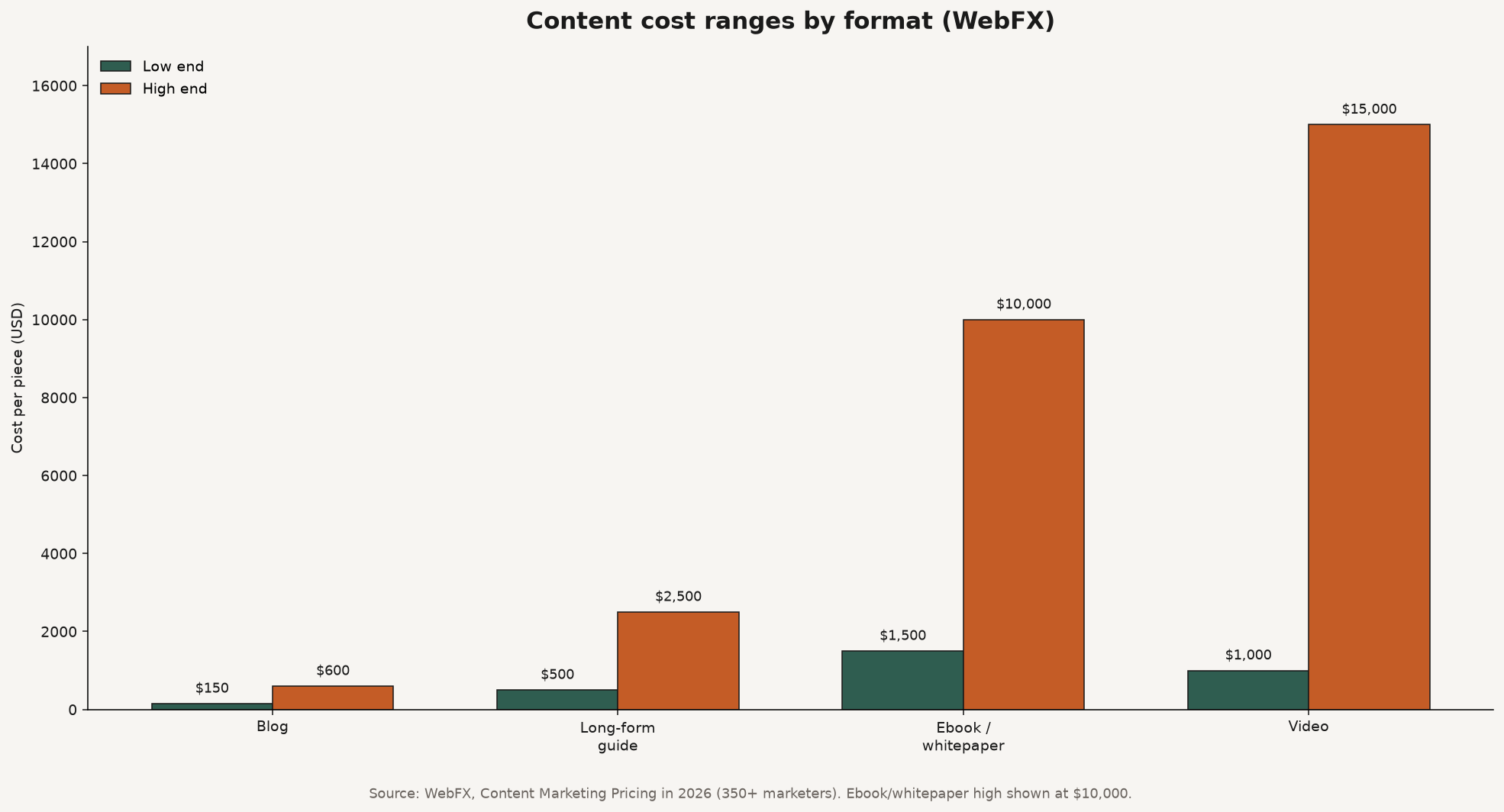
Source: WebFX, Content Marketing Pricing in 2026 (survey of 350+ digital marketers). https://www.webfx.com/content-marketing/pricing/.
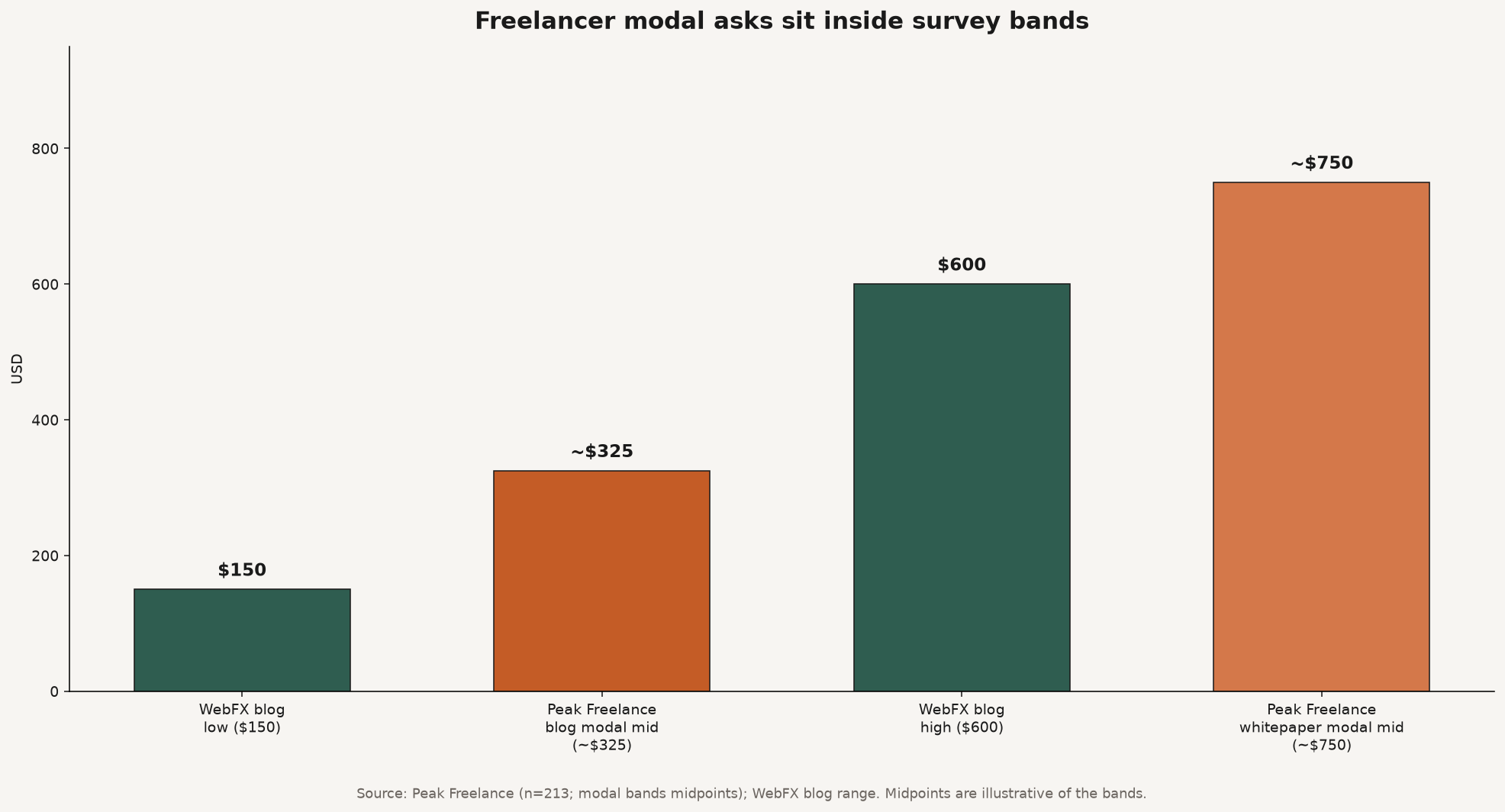
Source: Peak Freelance Freelance Writing Rates survey (n=213); WebFX blog range. https://peakfreelance.com/blog/freelance-writing-rates/ ; https://www.webfx.com/content-marketing/pricing/.
Content piece costs differ by format because research depth, production craft, and revision risk do not scale with word count alone. Delivery model (freelancer, agency retainer, in-house) then multiplies or hides the overhead. Open with ranges, then decide whether you are buying a draft or a finished asset in market.
| Format (WebFX 2026 breakdown) | Published cost range | Typical scope note from same source |
|---|---|---|
| Blog content | $150-$600 per post | Often ~1,000-1,500 words |
| Long-form articles / guides | $500-$2,500 per article | Expertise and industry drive the band |
| Ebook / whitepaper | $1,500-$10,000+ | Higher word count and research load |
| Video production | $1,000-$15,000 per video | Social clips vs crewed long-form |
| Social media content | $500-$5,000+ per month | Packs of posts, not one graphic |
Source: WebFX Content Marketing Pricing.
Peak Freelance adds the freelancer lens for writing: modal whitepaper asks sit at $500-$999, yet 55% of writers who offer whitepapers charge $1,000+, and 17% charge more than $3,000 (Peak Freelance). That spread is the point. “Whitepaper” can mean a light PDF or a researched lead magnet with interviews.
| Model (WebFX) | Monthly band | What you are actually buying |
|---|---|---|
| Agency monthly retainer | $1,000-$20,000 | Ongoing creation under a fixed fee |
| Freelancer capacity | $1,000-$10,000/mo or $60-$200+/hr | Variable quality and management load |
| In-house team | $5,000-$25,000+/mo | Salaries, benefits, tools, management |
Source: WebFX.
WebFX’s own list packages are a clean unit-cost check. Basic is $1,800 for 3 assets, Aggressive $3,600 for 6, Market Leader $6,000 for 10. Divide list price by asset count and each plan lands at $600 per asset before you argue about which asset types fill the slots. That is a labeled package-math observation from published plan rows, not a claim that the market mean is $600 (WebFX plan table).
Adjacent line items from the same WebFX FAQ cut: content audits often $100-$700 (53% of respondents), website content often $501-$1,000 per month (22%), and updates/refreshes often $501-$1,000 per month (27%) (WebFX). Refreshes are how you stop paying full freight for every URL in a topic cluster.
Orbit finds almost everyone touches AI, but marketers who use AI to write complete articles are the least likely to report “strong results” in that sample (Orbit Media). Cost falls faster than quality unless review stays in the loop.
Starr Conspiracy’s proprietary B2B tech survey (312 organizations, $10M-$500M revenue, fielded April-June 2024) reports a median fully loaded cost per published long-form asset of $847 for AI-augmented teams versus $2,310 pre-AI, with time-to-first-draft falling from 4.6 hours to 1.1 hours (Starr Conspiracy). Keep that inside its sample. It is not a SMB freelance census, and it is not permission to ship unreviewed drafts.
There is no public dataset here that proves a universal all-in multiplier such as “always 2x the writing invoice.” The useful move is to name the stack: brief, research, draft, edit, design, CMS, internal links, distribution. If a quote only covers draft, your real cost is higher. Full stop.
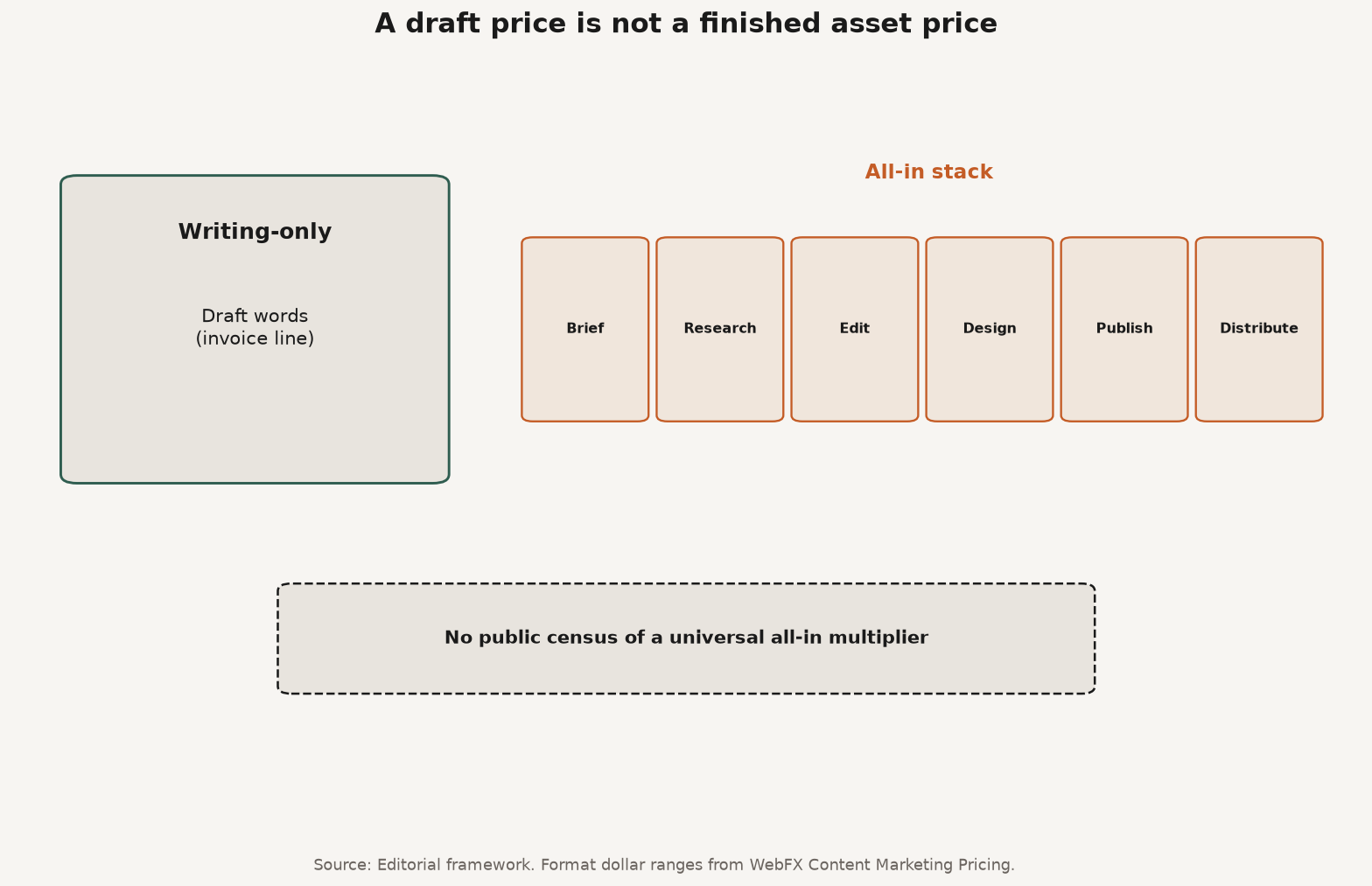
Source: Editorial framework. Dollar ranges for formats from WebFX; refuse a universal all-in multiplier census. https://www.webfx.com/content-marketing/pricing/.
Reddit still runs the same argument: $50/post packages that “include strategy” are labor math that does not work, while $350 for a researched B2B piece can be a bargain. Believe the hours, not the vibes.
These answers restate the WebFX format ranges, the Peak Freelance modal asks, and the hard refusal of a single national average. Use them when someone wants a number fast, then open the comparison table when they start budgeting a real calendar.
Q: What is the average cost per content piece by format? A: Use ranges. WebFX’s 2026 breakdown puts blogs at $150-$600, long-form guides at $500-$2,500, ebooks/whitepapers at $1,500-$10,000+, and video at $1,000-$15,000. There is no trustworthy single national mean for “a content piece.”
Q: How much does a blog post cost from a freelancer? A: In Peak Freelance’s survey of 213 writers, the most common ask for a 1,500-word blog is $250-$399 (27% of respondents). Six-figure freelancers often charge $1,000 or more for the same length.
Q: How much should a company budget for content marketing per month? A: WebFX frames monthly content marketing spend from about $1,000 to $20,000+, and reports that 58% of businesses fall in the $5,001-$10,000 band in its cost-of-marketing cut. Your mix of video and whitepapers will push you up the band.
Q: Does AI make content much cheaper? A: It can cut draft time. Orbit finds nearly all surveyed marketers touch AI, but using AI to write complete articles correlates with weaker self-reported results in that sample. Starr Conspiracy’s B2B tech sample reports median fully loaded long-form cost falling from $2,310 to $847 with AI-augmented workflows. Keep review.
Q: Why shouldn’t I use one average cost per blog post in my plan? A: Because public sources publish bands and modal asks, not a census mean for every US blog post. A point estimate hides quality tier, SME time, design, and distribution. Plan with ranges and an all-in checklist instead.
Average cost per content piece by format is a budgeting grammar, not a single cell. WebFX gives format bands and a common monthly spend cluster. Peak Freelance shows where freelancers quote. Orbit shows the hours. Treat any deck that flattens those into one average as incomplete. Build from ranges, then fund the stack that turns a draft into an asset.
If you want partners who can distribute finished offers instead of only producing more pages, start at feat..
Evergreen vs trending content compared with OkDork share-decay data, evergreen format odds, and a job-first mix (not a fake 70/30).
How long content takes to rank by domain authority, with Ahrefs base rates, page-age data, and why DA score calendars are mostly fiction.
Content repurposing frameworks: CMI challenge rates, a job-first pillar-to-derivative map, and why rewrite-not-reformat beats paste-and-pray.